


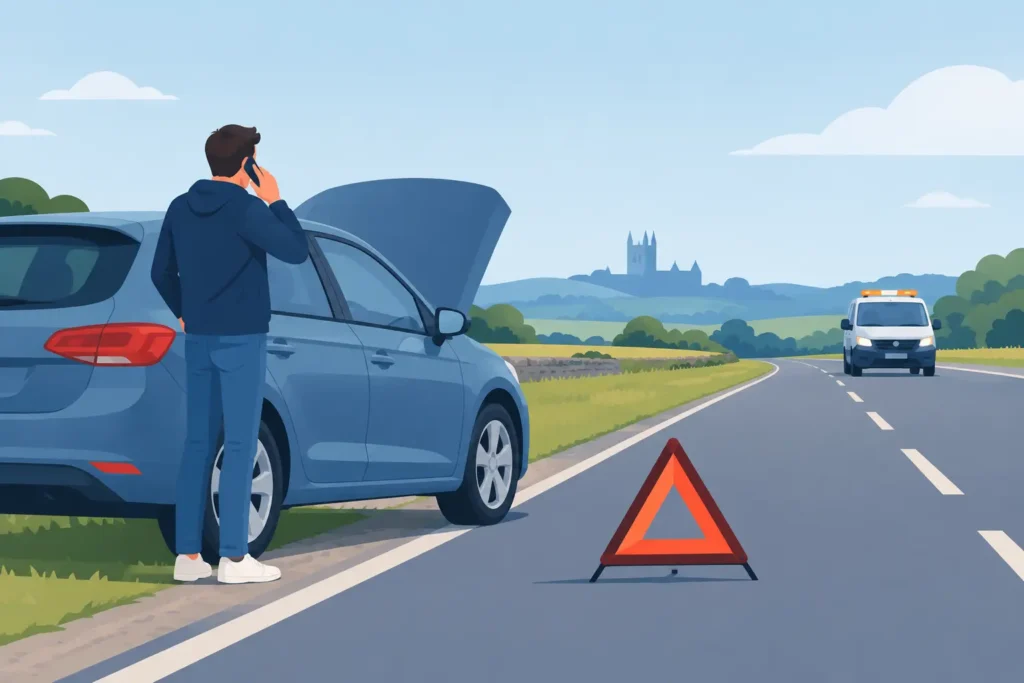
Your car has lost power on the M4, a warning light is flashing, or you have a flat tyre on a dark country road. The first few minutes matter most. Knowing what to do after car breakdown can keep you, your passengers and other road users safe while getting help on the way.
Do not rush into repairs at the roadside, especially near fast-moving traffic. Your priority is to get out of danger, make your vehicle visible and arrange professional recovery to a safe location.
What to Do After a Car Breakdown Safely
If the vehicle is still moving, stay calm and steer smoothly. Switch on your hazard warning lights straight away, reduce speed gradually and look for the nearest safe place to stop. A lay-by, service area, car park or quiet side road is usually far safer than stopping on a live carriageway.
Avoid harsh braking or sudden steering, particularly if you have a tyre problem or steering fault. If the engine has failed, you may find the steering and brakes feel heavier than normal, but they should still work. Use steady pressure and focus on reaching somewhere away from traffic.
Once stopped, apply the handbrake, select park or first gear, switch on your sidelights if visibility is poor and turn the wheels away from the road where possible. Keep hazard lights on while your vehicle presents a risk to approaching traffic.
Get yourself and passengers to safety
On a quiet road, leave the vehicle from the side away from moving traffic if it is safe to do so. Take passengers with you, including children and pets, and wait well away from the carriageway. Never stand in front of or behind the vehicle, as another driver may not see it in time.
Motorways and dual carriageways need extra care. If you can reach a service station, lay-by or emergency refuge area, do so. If you stop in an emergency refuge area, use the roadside emergency telephone where available and follow the instructions shown. If your vehicle is stranded in a live lane and cannot be moved, keep seatbelts on, switch on hazard lights and call 999. Do not attempt to cross a motorway or walk along it unless instructed by emergency services.
If you are on a hard shoulder, leave the vehicle only when it is safe and wait behind the barrier, well away from traffic. If there is no barrier, move up the verge and away from the road. Do not try to inspect a wheel, look under the bonnet or unload belongings beside high-speed traffic.
Make Your Vehicle Easy to See
Hazard lights are your first warning to other drivers. At night, in heavy rain, fog or poor daylight, keep your sidelights on as well if the battery allows. Visibility is not just about preventing a collision – it also helps a recovery driver find you faster.
A warning triangle can be useful on a quiet road with enough space and clear sight lines. It should only be placed if you can do so without putting yourself at risk. Never use one on a motorway or high-speed dual carriageway, and never walk into traffic to position it.
If you have a high-visibility jacket, put it on before leaving the vehicle. Keep it in the passenger compartment rather than buried in the boot, where it may be difficult or unsafe to reach after a collision. A torch, charged phone and warm layer are also worth having close by, especially during winter journeys.
Decide Whether You Need Recovery or Roadside Help
Some faults can be resolved at the roadside. A flat battery, an empty fuel tank, a puncture where you have a safe spare and the right equipment, or a key issue may not require a tow. Even then, safety comes first. If the location is exposed, the weather is poor or you are unsure of the fault, recovery is usually the sensible option.
Do not continue driving if you see smoke, smell burning, notice leaking fuel, have severe tyre damage, lose braking performance or receive a serious engine or battery warning. Continuing can turn a manageable fault into major damage, and it may put other people at risk.
Electric vehicles need the same careful approach, with a few extra considerations. If the vehicle has run out of charge, do not assume a standard jump start or tow is suitable. EVs can require compatible transport and handling to protect the drivetrain and high-voltage system. Tell the recovery provider that it is an electric vehicle and explain any dashboard warnings you can see.
The same applies to vans, motorcycles and vehicles with axle, wheel or suspension damage. A basic tow is not always appropriate. The right recovery vehicle and equipment protect your vehicle from further damage during loading and transport.
Give the Recovery Team the Right Details
A clear call helps a recovery team reach you without delay. Start with your exact location. If you are on a motorway, share the motorway number, direction of travel, nearest junction and any marker post or emergency refuge area details. On local roads, provide the road name, village or town, nearby landmarks and your vehicle registration.
Then explain what has happened. Mention whether the vehicle is safely parked, whether it starts, whether wheels are damaged or locked, and whether you are carrying passengers. Tell the operator if you are in a vulnerable position, travelling with young children, or stuck on a busy route such as the M25, M4 or M3.
It also helps to say where you need the vehicle taken. That could be your home, a garage, a dealership or another agreed destination. If you do not know yet, a professional recovery service can advise on the safest next step based on the fault, time of day and distance involved.
Have your phone switched on, with the volume up, and keep it available for the driver. If your battery is low, use low-power mode and avoid unnecessary calls. Recovery crews often need to confirm your position as they get close, especially on rural roads or complex motorway junctions.
What Not to Do at the Roadside
Breakdowns create pressure, and that is when poor decisions happen. Do not accept help from an unverified person who offers to tow your vehicle. Do not allow an unsuitable vehicle to pull your car with a rope on a busy road. Do not sit in a dangerous position simply because you want to stay warm or protect your belongings.
Avoid opening the bonnet if there is smoke, steam or a strong burning smell. Move away from the vehicle and call emergency services if you believe there is a fire or fuel leak. If your vehicle has been involved in a collision, check for injuries first and call 999 where anyone is hurt, the road is blocked or there is an immediate danger.
You should also resist the temptation to keep trying the ignition. Repeated attempts can flatten the battery or worsen a mechanical issue. One brief attempt may confirm the problem, but if the vehicle will not start or runs badly, stop and arrange assistance.
Fast Recovery When You Need It Most
A breakdown does not always happen near home, during daylight or when you have time to spare. Whether you are stranded outside Reading, on a Berkshire country lane, heading through South Oxfordshire or caught on a major motorway route, the aim is simple: get you to safety and get your vehicle handled properly.
Ozzy’s Breakdown Recovery provides 24/7 roadside assistance and vehicle recovery for cars, motorcycles, vans, commercial vehicles and EVs. A trained recovery team can assess the situation, carry out suitable roadside help where possible and transport your vehicle safely when it cannot be driven. Clear communication and the right equipment make a stressful stop far easier to manage.
Keep a recovery number saved in your phone before your next journey. If a breakdown happens, focus on getting safe first. The vehicle can be recovered, repaired and back on the road – but your safety cannot wait.