


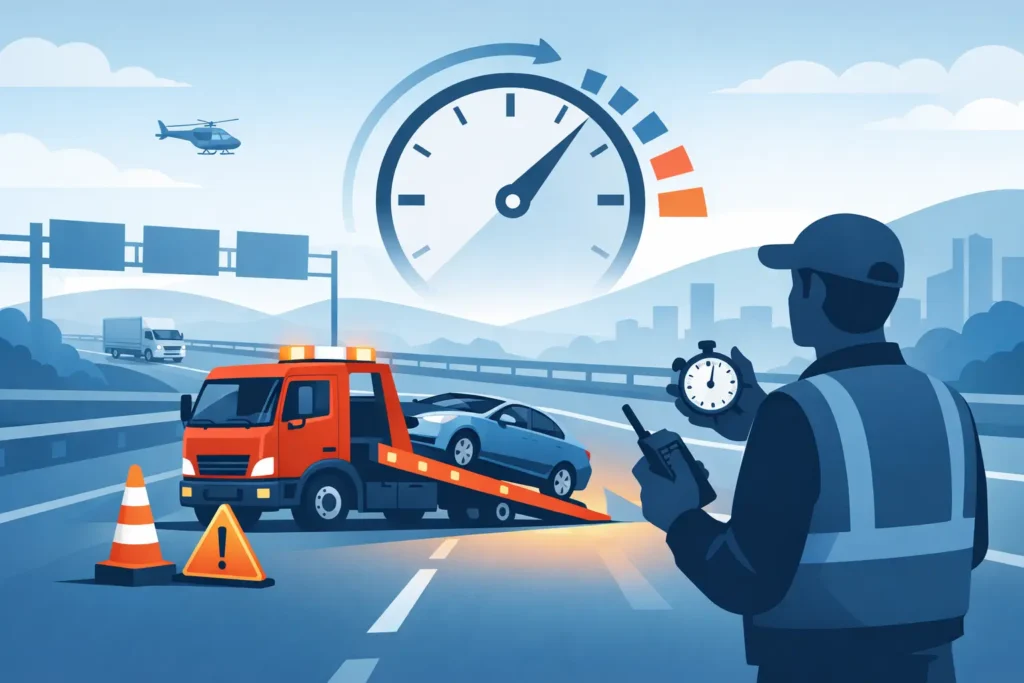
A breakdown on the motorway feels different from one on a local road. Traffic is moving fast, there is less room to wait safely, and every minute can feel longer than it is. That is why motorway recovery response times matter so much. Drivers do not just want help at some point – they want to know how quickly it can realistically arrive, what might delay it, and what happens in the meantime.
If you are stranded on the M4, M25, M3 or another busy route, response time is not a simple promise pulled from thin air. It depends on where you are, the condition of the vehicle, traffic levels, lane access, and whether the job is a roadside fix or a full recovery. A good recovery company will tell you what is realistic, keep you updated, and get moving without wasting time.
What affects motorway recovery response times?
The biggest factor is location. A vehicle stopped near a motorway services area or a standard hard shoulder is often easier to reach than one in a live lane, a smart motorway refuge area, or a restricted section with traffic management in place. Recovery operators may need to approach from a specific direction or work within motorway safety procedures, which can add time.
Traffic conditions play a major part too. A 30 to 45 minute response can be realistic in many cases, especially when a local operator already covers that corridor and has a vehicle nearby. But rush hour queues, roadworks, collisions ahead, or lane closures can turn a short drive into a much longer one. Night-time can sometimes be faster because roads are clearer, although fewer safe access points and reduced visibility can create other delays.
Vehicle type also matters. A standard car with a flat battery is not the same job as a long-wheelbase van with axle damage or an electric vehicle that needs the correct handling equipment. The more specialist the recovery, the more important it is that the right vehicle and tools are dispatched first time. Sending the wrong lorry quickly is not a fast service if it means waiting again.
Then there is the difference between roadside assistance and recovery. Some callouts can be resolved on the spot with a jump start, wheel change or minor fix. Others need towing or transport. In practical terms, motorway recovery response times are often quoted as the time for the operator to reach you, not the time for the whole incident to be finished. Recovery, loading and onward transport can add another stage depending on the fault.
Why quoted times are not always the same as arrival times
Many drivers hear a target response window and treat it as a guarantee. That is understandable, especially when you are under stress. But there is a difference between an estimated time and a fixed arrival time.
A reliable recovery company should give you a clear estimate based on live conditions, not just a best-case answer. If the operator says 30 to 45 minutes, that should reflect current traffic, distance and job type. It should not mean 30 minutes in perfect conditions and silence if the wait runs longer. Good communication matters nearly as much as speed when you are stuck on the motorway.
There is also a trade-off between speed and suitability. If a company promises the fastest possible attendance but turns up without the right kit for a motorcycle, van, EV or non-runner, you lose more time overall. On busy routes, proper dispatch matters. The quickest useful response is better than the quickest incomplete one.
Motorway recovery response times on busy routes
Not all motorways behave the same way. The M25 can be heavily affected by congestion and incidents spreading quickly across junctions. The M4 combines long commuter stretches with airport traffic and commercial use. The M3 regularly sees busy flows around peak times and holiday travel. On these corridors, response times can change quickly even within the same hour.
That is why local coverage matters. A recovery business already operating across Berkshire, South Oxfordshire and nearby motorway routes has a practical advantage over a provider sending help from farther out. Familiarity with junction layouts, service areas, diversion routes and known bottlenecks helps reduce wasted time. It also helps when a driver is not entirely sure where they are, which is common in stressful situations.
For fleet operators and van drivers, this can be even more important. Downtime costs money, missed drops create knock-on problems, and waiting on the hard shoulder with tools or stock in the back is never ideal. Fast response matters, but so does a team that understands urgent commercial recovery and treats it as such.
What you can do to avoid unnecessary delays
When you call for help, the most useful thing you can provide is your exact location. That means motorway number, direction of travel, nearest junction, and any marker post or emergency area reference you can see. If you are near a slip road, bridge, services or a clear landmark, mention that too.
Be clear about the vehicle and the fault. Say whether it is a car, motorcycle, van, electric vehicle or something with visible damage. If the wheel is broken, steering is affected, or the car cannot be rolled freely, say so early. This helps the recovery operator send the right vehicle first time.
Tell them whether you are in a hard shoulder, emergency area or live lane position. Safety comes first, and some motorway situations may require coordination before recovery can begin. The clearer the information, the less chance of delay at dispatch stage.
Keep your mobile phone available and answer updates. If traffic conditions change and your ETA needs revising, you are better off knowing than guessing. A no-nonsense service should keep you informed rather than leaving you wondering whether anyone is actually on the way.
When a fast response is realistic and when it is not
In many cases, a well-placed local operator can reach motorway callouts within 30 to 45 minutes. That is a sensible target when the job is within the main coverage area, traffic is manageable, and no specialist constraints slow access down. For drivers on major routes around Reading, Berkshire and surrounding areas, that kind of response can be the difference between a stressful delay and a controlled recovery.
But there are times when it will take longer, and honest companies should say so. A serious incident nearby, police-managed traffic, dangerous weather, multiple callouts at once, or a difficult recovery situation can all affect timing. The question is not whether delays ever happen. The question is whether the company is upfront, properly equipped and still moving as quickly as conditions allow.
That is where a service-first operator stands out. Ozzy’s Breakdown Recovery focuses on 24/7 attendance, practical response windows and the ability to handle more than the basic callout. That includes cars, motorcycles, vans, commercial vehicles, EVs and more awkward recovery scenarios where a standard tow is not enough. For the customer, that means less passing around, fewer wasted calls and a better chance of getting the right help without delay.
Why speed matters, but trust matters more
A motorway breakdown puts people under pressure. You may be late for work, stuck with family in the car, trying to protect business deliveries, or simply worried about being in an exposed location. Fast attendance matters because it reduces risk and gets the problem moving towards a solution.
Still, speed on its own is not the whole service. You need clear communication, professional handling and confidence that the vehicle will be recovered safely. A rushed operator who is hard to reach, vague on timing or careless with loading does not make the situation better. The best recovery services combine urgency with competence.
That is what most drivers are really looking for when they ask about motorway recovery response times. Not a sales line, but a realistic answer backed by action. If help can be there fast, you want it dispatched immediately. If conditions mean a longer wait, you want an honest ETA and proper updates.
When you are stranded on a motorway, certainty is hard to come by. The right recovery service makes it easier by being direct, available and ready to act. In that moment, the most reassuring thing is not hearing the perfect promise – it is knowing the right team is already on the way.