


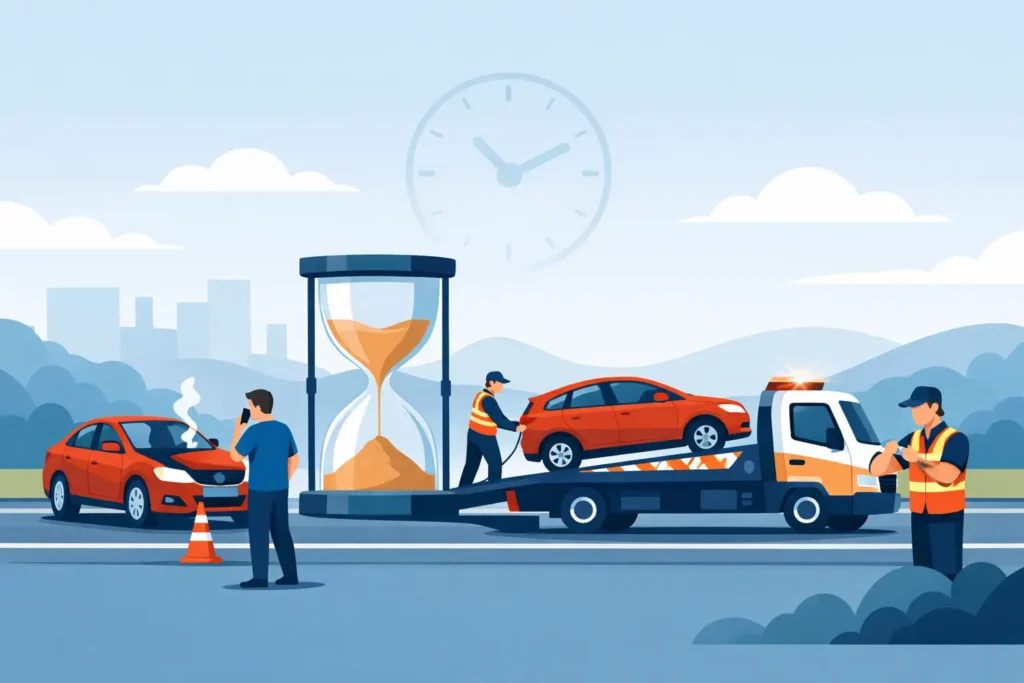
A breakdown never happens at a convenient time. Whether you are stopped on the M4 near Reading, outside work in Berkshire, or on a quiet road in South Oxfordshire, the first question is usually: how long does vehicle recovery take? The honest answer is that it depends on your location, the condition of the vehicle and how safely it can be recovered. But a professional local recovery service should give you a clear arrival estimate, keep you updated and get you moving as quickly as conditions allow.
For many standard breakdown callouts, a recovery vehicle can arrive within 30 to 60 minutes. At Ozzy’s Breakdown Recovery, we aim for a 30-45 minute response where traffic, weather and the nature of the incident allow. Once on scene, a simple issue may be resolved quickly. A vehicle that needs transporting, particularly after an accident or with axle damage, will naturally take longer.
How Long Does Vehicle Recovery Take After a Breakdown?
There are really three parts to recovery time: getting a recovery operator to you, assessing and securing the vehicle, then taking it to your chosen destination. It is worth separating these stages, because a quick arrival does not always mean the whole job will be finished in a few minutes.
For a straightforward callout such as a flat battery, wrong fuel situation, minor roadside fault or a tyre-related issue, the assessment may take 10-20 minutes. If the problem can be dealt with safely at the roadside, you could be back on the road shortly afterwards.
If your vehicle will not start, has a serious mechanical fault or cannot be driven safely, the operator will load or secure it for transport. This commonly takes around 20-45 minutes, depending on the vehicle and the space available. The final part is the journey to a garage, your home, a dealership or another agreed location. A local tow may be completed within an hour, while a longer onward journey will add to the total time.
What Affects Vehicle Recovery Response Times?
No reputable recovery company should promise an exact minute before it knows where you are and what has happened. Conditions on the road matter, especially around busy motorway corridors such as the M25, M4 and M3. The key factors are usually practical ones.
Your exact location
A car in a supermarket car park is generally easier and faster to reach than one on a motorway hard shoulder, a narrow country lane or a road closed after an incident. Clear location details save valuable time. If you are on a motorway, tell the operator the motorway number, direction of travel, nearest junction and any marker post details you can see safely.
A recovery vehicle may also need to approach from a particular direction where there are central reservations, roadworks or traffic restrictions. On rural roads, access can be slower if the vehicle is blocked in, on soft ground or down a very narrow lane.
Traffic, weather and time of day
Peak-time traffic can slow both the recovery vehicle’s arrival and the onward journey. Heavy rain, snow, flooding, high winds and poor visibility can also make loading and towing slower because safety has to come first.
A 24/7 service means help is available overnight, at weekends and on bank holidays. However, a busy period with several accidents or severe weather can mean longer waits than usual. A good recovery operator will be upfront about that rather than leave you guessing.
The type and condition of your vehicle
A standard car that rolls freely is often straightforward to load. A non-runner with locked wheels, a vehicle with suspension or axle damage, or a car involved in a collision can require specialist equipment and more careful handling. Motorcycles, vans, electric vehicles and light commercial vehicles may also need the right recovery set-up.
This is not wasted time. Correct loading protects your vehicle, other road users and the recovery team. Trying to rush an unsafe lift can create further damage and delay the job even more.
Whether the vehicle can be repaired at the roadside
Sometimes recovery does not mean a tow. A flat battery may only need a jump start. A minor issue may be identified and resolved on site, saving the time involved in loading and transport.
Other faults should not be patched up at the roadside. Engine warning lights, overheating, damaged tyres, accident damage, gearbox problems and EV faults can make continued driving unsafe. In those cases, taking the vehicle to a safe destination is the right call, even if it takes longer than a quick fix.
How Long Does Loading and Towing Take?
Once the recovery vehicle has arrived, most customers want to know whether they can be on their way immediately. For an uncomplicated car recovery from a safe, accessible place, loading may take 15-30 minutes. The vehicle needs to be checked, positioned correctly, secured and inspected before the recovery vehicle moves off.
An accident recovery can take considerably longer. The vehicle may be damaged, leaking fluids, obstructing traffic or unable to roll. Police, highways officers or emergency services may be managing the scene, and their instructions must be followed. In some cases, the recovery operator cannot begin work until the area is safe and authorised for access.
A van or commercial vehicle can also take longer than a private car, especially if it is loaded, has suffered a wheel or axle problem, or needs specialist transport. For businesses, that extra care matters. Proper recovery reduces the risk of additional damage and helps get the vehicle to a repairer or secure base in the right condition.
Electric Vehicle Recovery Times
Electric vehicle recovery follows the same basic process, but it is not always the same as recovering a petrol or diesel car. An EV with a flat drive battery may need a suitable recovery method rather than an improvised tow. Faults involving the charging system, battery warnings or accident damage require sensible handling by a team equipped for EV recovery.
That may add some assessment time, but it is the safer option. Tell the recovery company that your vehicle is electric when you call, along with the make and model if possible. This helps ensure the correct equipment is sent from the start.
What to Do While You Wait for Recovery
The most useful thing you can do is make yourself and your passengers safe. The recovery team can work faster when they have accurate details and you are already in a safe position.
- Move to a safe place away from live traffic where possible. On a motorway, follow official guidance and do not remain in the vehicle if it is unsafe to do so.
- Switch on your hazard warning lights and use a warning triangle only where it is safe and appropriate.
- Keep your phone charged, listen for calls from the recovery operator and have your location details ready.
- Tell the operator about passengers, pets, accessibility needs, dangerous road conditions and any visible vehicle damage.
Do not attempt repairs beside fast-moving traffic or try to push a vehicle from a dangerous position. A few minutes spent protecting yourself is more important than any delay to the journey.
When Recovery May Take Longer Than Expected
Most recovery delays have a clear reason. A collision on a major route, a vehicle in a hazardous location, extreme weather, road closures or a difficult loading position can all extend the job. There may also be a delay if the chosen garage is closed, full, or unable to accept the vehicle outside working hours.
If you need recovery outside garage opening times, ask about taking the vehicle home, to a secure location or to a repairer that can receive it. Being clear about your destination at the beginning avoids last-minute changes and helps the operator plan the right route.
For planned vehicle transport, giving advance notice usually makes timing more predictable. For emergency breakdowns, the priority is different: arrive safely, assess the situation properly and get the vehicle and its occupants out of trouble without cutting corners.
If you are stranded now, focus on sharing your exact location and vehicle details when you call. The right recovery team will give you a realistic arrival estimate, handle your vehicle with care and keep the stress to a minimum while you wait.