


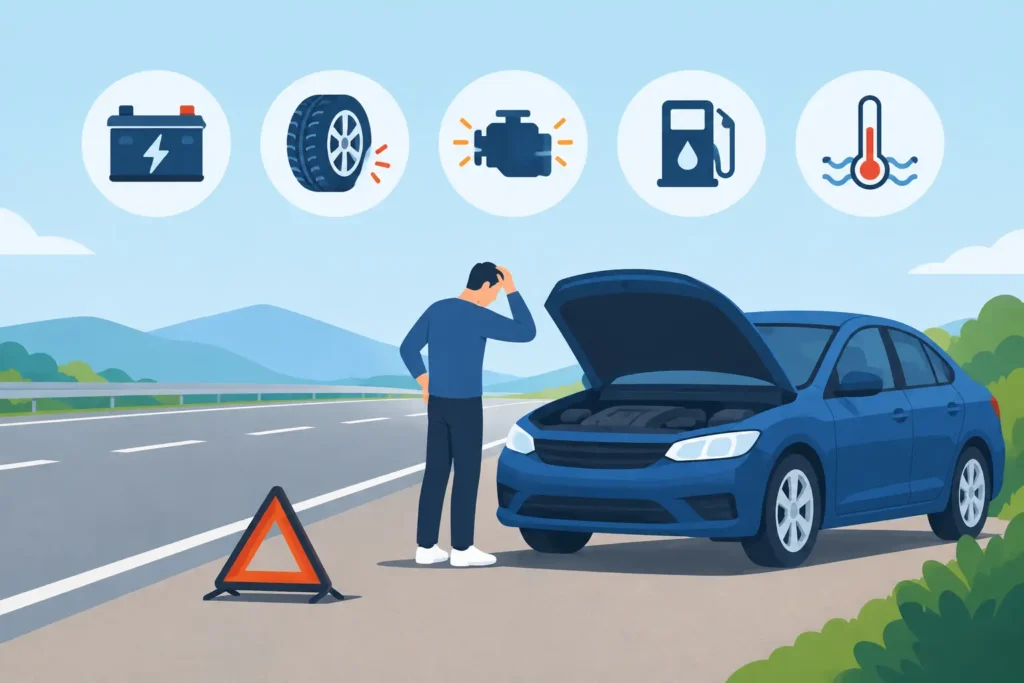
A breakdown rarely gives you a convenient warning. It can happen on the school run, halfway through a delivery, or while travelling along the M4, M25 or M3 at night. Understanding the top causes of roadside breakdowns can help you spot trouble earlier, but if your vehicle has already stopped, safety comes first: get as far from live traffic as possible, switch on your hazard lights and arrange professional recovery.
Flat or failing batteries
A flat battery is one of the most common reasons drivers need roadside assistance. Cold mornings put extra strain on older batteries, but the problem is not limited to winter. Short journeys, leaving lights or accessories on, loose terminals and a failing alternator can all leave a vehicle unable to start.
You may notice slower cranking when starting, dim dashboard lights or electrical functions behaving oddly. Do not assume a jump start is always the full answer. If the battery repeatedly goes flat, the vehicle may have a charging fault or an electrical drain that needs checking before it leaves you stranded again.
For many cars and vans, a safe jump start gets you moving. However, modern vehicles have sensitive electrical systems, and incorrect jump-starting can cause further problems. Hybrid and electric vehicles require particular care, as their high-voltage systems must never be treated like a standard 12-volt battery setup.
Tyre damage and punctures
Punctures, sidewall damage and blowouts are another frequent cause of roadside stops. Potholes, debris, nails and kerb impacts can all damage a tyre, sometimes without an immediate flat. Driving with under-inflated tyres also increases heat and wear, making failure more likely at motorway speeds.
A steering wheel that pulls to one side, repeated loss of pressure or a visible bulge in the sidewall means the tyre needs attention. If a tyre fails while driving, hold the steering wheel firmly, slow down gradually and avoid sharp braking or sudden movements.
Not every vehicle carries a spare wheel. Many now have a sealant kit, which may not work on a large puncture, sidewall damage or a tyre that has come off the rim. If you are on a busy road or motorway hard shoulder, changing a wheel yourself may be unsafe. Recovery or roadside help is often the sensible option.
Engine overheating and cooling system faults
Steam from under the bonnet, a rising temperature gauge or a coolant warning light should never be ignored. Overheating can result from a coolant leak, split hose, failed radiator fan, damaged water pump or thermostat fault. Continuing to drive risks serious engine damage and can turn a manageable repair into a costly one.
Pull over safely as soon as you can. Switch off the engine and allow it to cool. Do not remove the coolant cap while the engine is hot – pressurised coolant can cause serious burns. Adding water may appear to solve the immediate issue, but it will not fix a leak or failed component.
Cooling faults can be difficult to judge at the roadside. A professional recovery service can transport the vehicle to a garage without risking further damage, particularly if the engine has already overheated or lost most of its coolant.
Fuel problems and contaminated fuel
Running out of fuel is more common than many drivers admit, especially where a faulty fuel gauge, unexpected diversion or long queue changes a planned journey. Diesel vehicles that are run completely dry can need more than a simple refill, as air may enter the fuel system.
Putting the wrong fuel in the tank is another urgent issue. Starting the engine after misfuelling can circulate petrol through a diesel system or diesel through a petrol system, leading to expensive damage. If you realise the mistake at the pump, do not start the vehicle or turn on the ignition. Move away from the pump only if it is safe to do so and arrange recovery.
Loss of power, stalling shortly after refuelling or unusual engine noise may also point to contaminated fuel. In each case, forcing the vehicle onwards is a poor gamble. Safe transport to a suitable repairer protects the engine and fuel system.
Alternator, starter motor and electrical faults
The battery gets blamed for plenty of no-start situations, but it is not always the cause. A failed alternator cannot keep the battery charged while you drive, while a faulty starter motor may prevent the engine from turning over even when the battery is healthy.
An illuminated battery warning light while the engine is running is a key warning sign. So are flickering headlights, failing electrical equipment and a burning smell from the engine bay. If the alternator fails, the vehicle may continue for a short distance on battery power, then stop completely. It is better to pull over somewhere safe before that happens.
Electrical faults can be especially disruptive in commercial vans, where missed jobs and delayed deliveries quickly add up. Fast recovery limits downtime and avoids leaving a vehicle stranded in an unsuitable or insecure location.
Clutch, gearbox and drivetrain problems
A clutch that slips, a gearbox that will not select a gear or a sudden grinding noise can bring a journey to an immediate end. These faults may develop slowly, with difficult gear changes, a high clutch biting point or a vibration under acceleration. They can also happen suddenly after a component failure.
Do not try to force a gear or keep driving with loud mechanical noises. A damaged clutch, gearbox, driveshaft or axle can worsen quickly, and some vehicles need specialist recovery rather than a standard tow. This is particularly true where an axle is damaged, wheels are locked or the vehicle is a non-runner.
Motorcycles need the same careful approach. A chain, puncture, electrical fault or mechanical failure can leave a rider exposed at the roadside, and the bike should be secured correctly for transport rather than improvised towing.
What to do when your vehicle breaks down
The right response depends on where you stop. On an ordinary road, move to a safe place away from moving traffic where possible. Use hazard lights, keep passengers clear of danger and do not stand between your vehicle and passing traffic. If you have broken down on a motorway, follow motorway safety guidance and use an emergency refuge area if you can reach one safely.
Call for help with clear details: your location, vehicle registration, make and model, the fault or warning lights you have seen, and whether the vehicle can roll or steer. Tell the recovery operator if you are in a vulnerable position, carrying passengers, towing a trailer or driving an electric vehicle. Those details help ensure the right recovery vehicle and equipment are sent first time.
Avoid accepting help from unverified people who stop at the roadside. A proper recovery operator should communicate clearly, handle your vehicle safely and explain the next steps, whether that is a jump start, roadside assessment or transport to a garage, home or another destination.
Reducing the risk before your next journey
No maintenance routine can prevent every failure, but basic checks make a genuine difference. Check tyre pressures and tread regularly, keep an eye on fluid levels, act on warning lights promptly and have the battery tested if it is several years old or starting feels sluggish. Before a longer trip, make sure you have enough fuel and do not ignore new noises, vibrations or changes in braking and steering.
For vans and business vehicles, planned checks are particularly worthwhile. A vehicle off the road does not just inconvenience the driver – it can affect customers, schedules and earnings. Addressing minor issues early is usually cheaper than arranging emergency repairs after a breakdown.
When the unexpected does happen, stay safe, give clear location details and get the vehicle recovered properly. Ozzy’s Breakdown Recovery provides 24/7 roadside assistance and vehicle recovery across Berkshire, South Oxfordshire and surrounding motorway routes, with professional help for cars, vans, motorcycles and EVs when you need it most.