


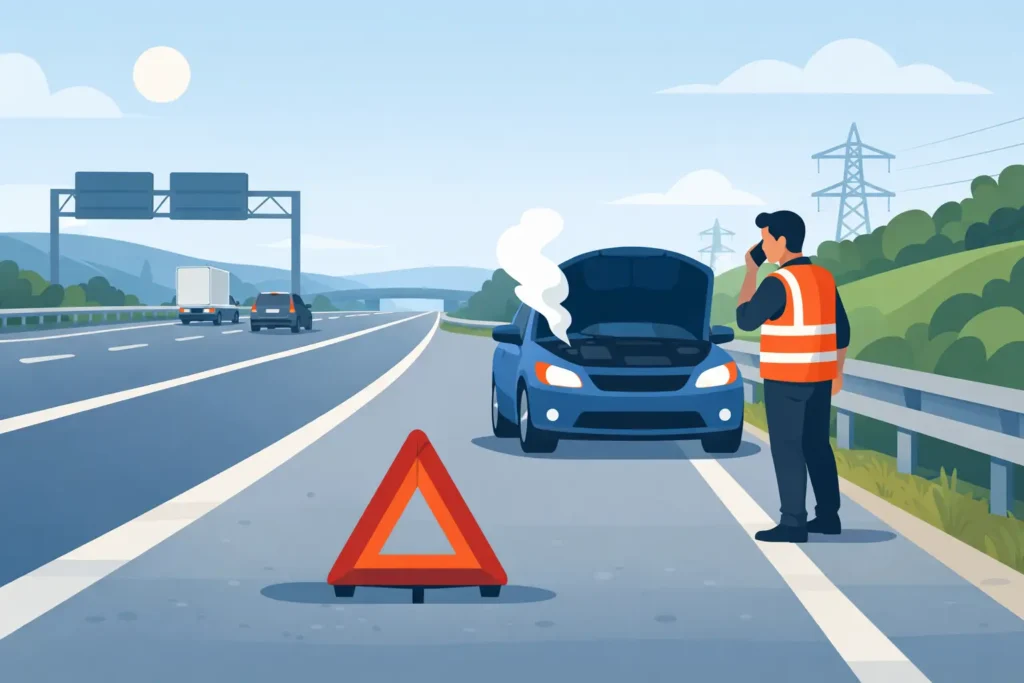
A breakdown at 70mph leaves little time to think. This motorway stopping guide gives you the clear, practical actions that matter most: get yourself out of danger, make your location known and arrange professional recovery without taking unnecessary risks.
Whether you are travelling on the M4 through Berkshire, approaching the M25, using the M3 or driving any other major route, your first priority is never the vehicle. It is you, your passengers and everyone around you.
Before You Stop on a Motorway
If your vehicle is still moving and you can do so safely, do not stop on the motorway itself. Put your hazard warning lights on, keep a steady course and aim for the next exit, motorway service area or other safe place away from live traffic.
A warning light, an unusual noise or a loss of air conditioning can be worrying, but it does not always mean you must stop immediately. Judge the problem carefully. If the steering, brakes, tyres, engine temperature or visibility are affected, treat it as urgent and reduce speed safely. Do not keep driving if doing so could cause a loss of control or further danger.
On a smart motorway, look for an Emergency Area. These are marked refuge areas set back from traffic, with orange roadside signs showing the distance to the next one. Use your left indicator early, enter slowly and stop as far to the left as possible. An Emergency Area is far safer than remaining in a live lane or stopping on the hard shoulder.
If you are on a conventional motorway with a hard shoulder and cannot reach an exit or services, move onto the hard shoulder, as far left as possible. Keep your wheels turned towards the left and switch on your hazard warning lights.
Motorway Stopping Guide: What to Do Once Parked
Once stopped, take a breath and assess whether it is safe to leave the vehicle. On a hard shoulder or in an Emergency Area, leave by the left-hand passenger door where possible. Get behind the safety barrier and move well away from the traffic. Keep passengers together, supervise children closely and take pets with you if it is safe to do so.
Do not stand in front of or behind the vehicle. Do not try to inspect an engine, change a wheel or make a roadside repair beside fast-moving traffic. A motorway is not a place for quick fixes, even if the fault seems minor.
Never place a warning triangle on a motorway. Walking back along the carriageway or hard shoulder to set one out puts you in unnecessary danger. Your hazard lights, a safe location and a call for help are the right response.
If you have stopped at an Emergency Area, use the SOS telephone if one is available. It gives the control centre your exact location and lets them arrange support quickly. If you call from a mobile, tell the operator the motorway name, your direction of travel, the nearest junction or marker post, and whether you are in a hard shoulder, live lane or Emergency Area.
Your location is one of the biggest causes of delay during a recovery callout. “Near Reading” is useful, but “M4 westbound, just after Junction 11, in an Emergency Area” is far better. It helps recovery teams plan the safest approach and bring the right equipment first time.
If You Are Stuck in a Live Lane
A vehicle that cannot move in a live motorway lane is an emergency. Put on your hazard warning lights immediately. If it is dark or visibility is poor, switch on your sidelights as well. Call 999 straight away and give your exact location, direction of travel, lane position and details of the vehicle.
If you can leave the vehicle safely, exit by the left-hand side and get behind a barrier. However, this depends on the traffic and where the vehicle has stopped. If it is unsafe to get out, stay inside with your seatbelt fastened, keep the hazard lights on and wait for the emergency services or motorway officers to make the area safe.
Do not attempt to push the vehicle out of a live lane. Do not walk along the carriageway to find help. Do not accept help from another driver if it means standing in traffic or moving around unprotected lanes. The risk from passing vehicles is far greater than the inconvenience of waiting for a controlled response.
Calling for Breakdown Recovery
Once you and your passengers are in a safe place, contact a recovery provider. Be ready to give the vehicle registration, make and model, the fault if known, your location and the number of people travelling with you. Let the operator know if you have children, vulnerable passengers, a pet, a motorcycle, a van, an electric vehicle or a loaded commercial vehicle.
This information affects the recovery plan. A flat battery may only need a jump start if you are safely off the motorway. A vehicle with wheel, axle or accident damage may need specialist lifting and transport rather than a basic tow. Electric vehicles also require correct handling, particularly after collision damage or when the battery system has been affected.
For drivers across Berkshire, South Oxfordshire and the surrounding M4, M25 and M3 routes, Ozzy’s Breakdown Recovery provides 24/7 emergency roadside assistance and recovery. The focus is simple: get to you quickly, keep the situation calm and move your vehicle safely to the right destination.
It may be your home, a local garage, a dealership or another agreed location. If you are unsure where the vehicle should go, explain the issue and your circumstances when you call. The quickest option is not always the best option if it leaves you stranded without a repair plan the next morning.
Smart Motorways Need Extra Care
Smart motorways can feel confusing because the hard shoulder may not be continuously available. Red X signs are especially important. Never drive in a lane marked with a red X, even if it appears clear. That lane may be closed because of a stopped vehicle, emergency response or an incident ahead.
If your vehicle develops a problem, use the next Emergency Area whenever possible. The signs show the distance, helping you decide whether you can reach it safely. If you cannot, get as far left as you can, use hazard lights and call 999 if you are stationary in a live lane.
A broken-down vehicle on a smart motorway needs a fast, professional response, but recovery teams may need traffic management or police support before they can reach it safely. This is why accurate information and following the emergency operator’s instructions matter.
Simple Checks That Reduce the Risk
Most motorway breakdowns cannot be predicted, but a few routine checks make a difference before a longer journey. Check tyre condition and pressures when tyres are cold, including the spare if your vehicle has one. Make sure you have enough fuel or battery charge for the route, plus a sensible margin for queues, diversions and cold weather.
Watch the temperature gauge, fuel warning light and any new dashboard messages before joining the motorway. If the vehicle has been making a serious noise, losing coolant, pulling to one side or struggling to start, get it looked at before a long run. Delaying a repair can turn a manageable garage visit into an unsafe roadside emergency.
Keep your phone charged where possible, but do not rely on it alone. Note major junctions as you travel, particularly if you are unfamiliar with the route. A charging cable, warm clothing, water and any essential medication are sensible to carry, especially when travelling with children or during winter.
Keep the Next Decision Safe
A motorway breakdown is stressful because the traffic does not slow down for your problem. Focus on the next safe decision rather than trying to solve the mechanical fault yourself: reach a safe place if you can, get behind a barrier when it is safe to leave the vehicle, call for the right help and wait where you are protected.