


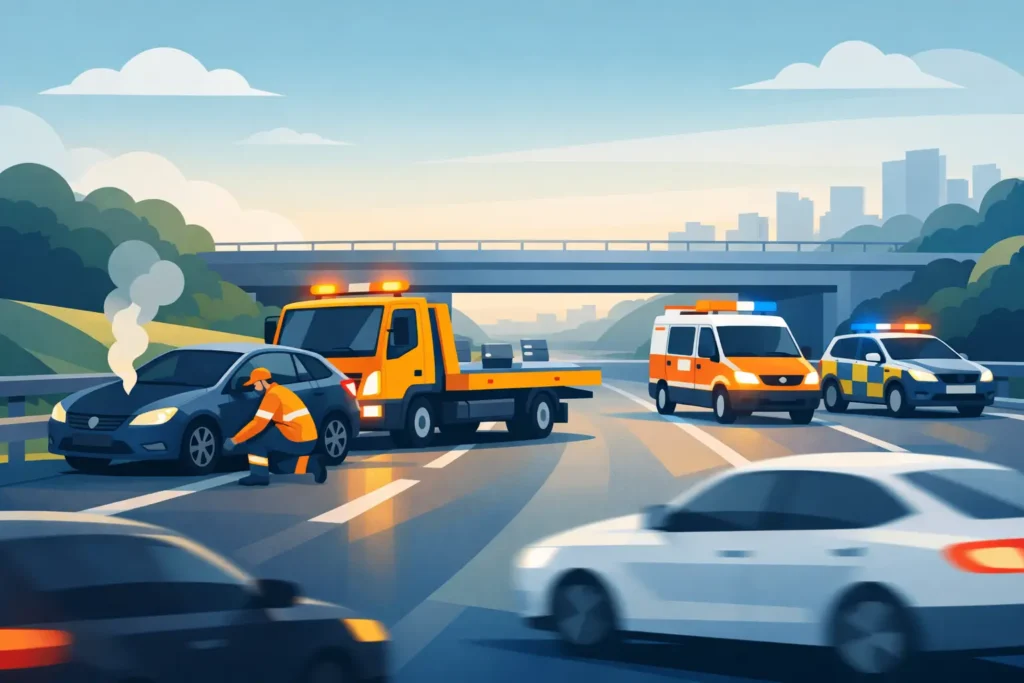
A breakdown on the M4 is never just inconvenient. It is fast-moving traffic, narrow hard shoulders in places, stressed drivers, and the pressure to get yourself and your vehicle somewhere safe quickly. That is exactly why motorway recovery M4 support needs to be fast, clear, and handled by people who know how to work under pressure.
If your car cuts out near Reading, you have a tyre issue outside Slough, your van loses power around Junction 12, or your EV stops with no usable charge, the priority is simple – safety first, then recovery without delay. On a motorway, there is no room for guesswork.
Why motorway recovery on the M4 needs a different response
Not every breakdown is the same, and not every road creates the same risks. A vehicle that stops on a quiet local road can often wait a little longer for assistance. A vehicle stranded on the M4 cannot. Traffic speeds are higher, visibility changes quickly, and drivers around you may have very little time to react.
That changes what good service looks like. You do not just need someone to turn up eventually. You need a recovery team that answers straight away, gives clear instructions, understands motorway procedures, and arrives ready to move the vehicle safely. The right operator will not waste time trying unsuitable fixes at the roadside if recovery is the safer option.
This is especially important on stretches of the M4 that carry heavy commuter traffic, airport journeys, business travel, and commercial transport. Delays build quickly. Stress builds even faster.
What to expect from motorway recovery M4 services
When you call for help on the M4, the process should feel straightforward even if the situation is not. You should be asked for your location, vehicle type, the fault if known, and whether you are in a place of relative safety. If you do not know your exact position, details such as the nearest junction, a marker post, or your direction of travel can help pinpoint you.
A proper motorway recovery M4 service should then focus on two things – getting to you promptly and getting the vehicle moved safely. In some cases, a roadside repair is possible. A flat battery, minor electrical issue, or simple mechanical fault may be dealt with on the spot. In other cases, recovery is the only sensible route.
That can include transport to your home, your garage, a workplace, or another safe destination. For business users, it may mean reducing downtime and keeping schedules from falling apart. For families, it may simply mean getting everyone off the motorway and back somewhere secure.
Common M4 breakdown callouts
Some problems are more common than others on motorway routes. Battery failure still catches drivers out, especially after short journeys, cold weather, or long periods without use. Tyre damage is another frequent issue, particularly after debris strikes or pothole impact near slip roads and lane edges.
Mechanical faults are also common. Overheating, clutch failure, engine warning lights, sudden loss of power, and transmission problems can all turn a normal journey into an emergency stop. Vans and heavier working vehicles often face added strain because of load weight and mileage, which means roadside recovery needs to be equipped for more than standard cars.
Then there are accident recoveries. Even low-speed collisions can leave a vehicle unsafe to drive. Axle damage, steering issues, bodywork interference with the wheels, or deployed safety systems can all mean the vehicle needs lifting and transporting rather than attempting to continue.
Cars, vans, motorcycles and EVs all need the right handling
One of the biggest mistakes drivers make is assuming all recovery is basically the same. It is not. A motorcycle needs secure loading and proper restraint points. A van may need a different recovery vehicle altogether, especially if it is carrying tools, stock, or equipment. A non-runner with wheel or axle damage needs specialist handling to avoid causing further problems during loading.
Electric vehicles add another layer. EV recovery is not simply a standard tow job with a different badge on the bonnet. Safe handling matters, and the team attending needs to understand how to transport an EV correctly. If the issue is depleted charge rather than a fault, the next step also depends on range, location, and whether onward travel is realistic.
This is where experience counts. On the M4, there is no value in a one-size-fits-all approach. The recovery solution has to match the vehicle and the situation.
Fast response matters, but communication matters too
When drivers talk about a good recovery service, speed is usually the first thing they mention. Fair enough. If you are stranded on the motorway, you do not want vague promises and long silences. But response time on its own is not the full picture.
You also want updates that make sense. You want to know that help is on the way, how long it is likely to take, and what happens next. That reassurance matters just as much when you are travelling alone late at night as it does when you have passengers, children, or business commitments waiting at the other end.
A dependable service should reduce stress, not add to it. That means answering the phone, being clear about the plan, and turning up with the right equipment rather than improvising once on scene.
What drivers should do while waiting on the M4
If your vehicle breaks down on the motorway, your first priority is to get to a place of safety if you can do so. If the vehicle will still move, leave at the next exit or reach an emergency area if one is available. If you cannot move off the carriageway, switch on your hazard lights and follow motorway safety guidance.
Once stopped safely, get yourself and any passengers behind the barrier where possible and away from traffic. If it is dark or conditions are poor, keep visible and stay well clear of the vehicle. Then call for recovery with the clearest location details you can give.
Do not stand next to the vehicle waiting for assistance. Do not attempt roadside fixes in live traffic conditions. On a motorway, small delays and risky decisions can become serious very quickly.
M4 coverage is about local knowledge as much as distance
The M4 is a major route, but breakdown response is not just about seeing the motorway on a map. It helps when the recovery team knows the junctions, common congestion points, access routes, and surrounding towns. A provider covering Berkshire and nearby motorway corridors can often respond more efficiently because they already work these roads day and night.
That local knowledge makes a real difference around busy sections near Reading, Maidenhead, Slough, and the surrounding links feeding traffic towards the M25, M3, and South Oxfordshire routes. It can shape approach times, loading decisions, and destination planning once your vehicle is recovered.
For private motorists, that means less uncertainty. For businesses running vans or light commercial vehicles, it can mean getting a working day back under control faster.
Choosing the right motorway recovery M4 provider
In an emergency, most people are not comparing five companies in detail. They want someone who answers and gets moving. Still, there are a few things worth looking for if you have the chance. Twenty-four-hour availability matters because M4 breakdowns do not keep office hours. The ability to recover different vehicle types matters because not every job is a standard car tow. Clear arrival estimates matter because being left guessing on a motorway is the last thing anyone needs.
It also helps to choose a service that can manage more technical recoveries, not just simple breakdowns. Accident-damaged vehicles, non-runners, axle issues, motorcycles, vans, and EVs all need proper equipment and trained handling. A team that deals with those jobs regularly is usually better prepared when the call comes in.
That is why drivers across Berkshire and the surrounding motorway routes often want a recovery company that is local, available 24/7, and used to urgent roadside work. Ozzy’s Breakdown Recovery is built around exactly that kind of response – fast, professional help when you need your vehicle moved safely and without fuss.
When the quickest fix is recovery, not repair
Some drivers understandably hope every breakdown can be solved at the roadside. Sometimes it can. Sometimes it should not be. If the vehicle is in a dangerous position, if the fault is more serious, or if there is any doubt about roadworthiness, recovery is usually the smarter option.
That can feel frustrating in the moment, especially if you were only halfway to work, heading to the airport, or trying to finish a delivery run. But a rushed temporary fix on the M4 is not always a win. Safe transport to a garage or secure destination is often the faster route to getting the problem sorted properly.
If you are stuck on the M4, the main thing is not to wait and hope it somehow improves. Get yourself safe, make the call, and let a recovery team take the pressure off before a bad situation gets worse.