


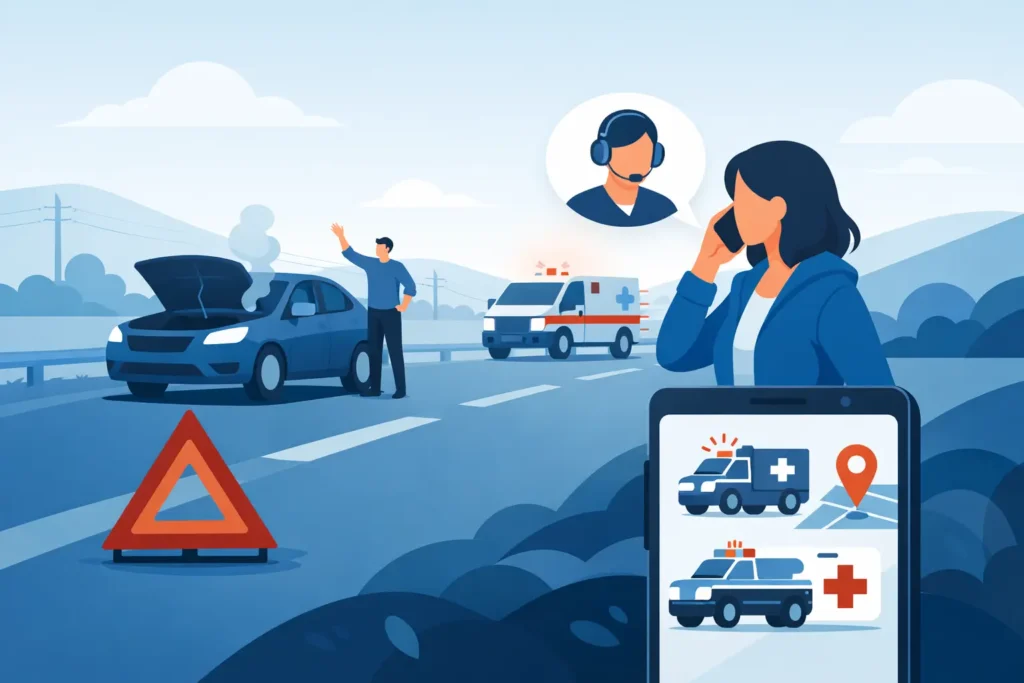
A breakdown on the M4, a tyre failure outside Reading or an accident on a country road can make it hard to think clearly. Knowing how to report roadside emergency situations gives the emergency services and your recovery provider the information they need to find you quickly, while helping you keep yourself and others safe.
Your first priority is never the vehicle. Get out of danger where it is safe to do so, make the right call for the situation, then give a clear location and accurate description of the problem. A professional recovery team can deal with a non-runner, damaged wheel, flat battery or EV fault. Immediate risks to life need the emergency services first.
Make the scene safe before you report a roadside emergency
If your vehicle is still moving, aim to leave the carriageway at the next safe exit, lay-by, service area or side road. Do not stop in a live lane unless the vehicle will not move. Put on your hazard lights as soon as you need to slow down unexpectedly or have stopped because of a breakdown.
On an ordinary road, pull as far left as practical without creating a new hazard. Switch on your sidelights if visibility is poor or it is dark. If you can leave the vehicle safely, passengers should wait well away from traffic, preferably behind a barrier or on a verge away from the road.
Motorways require extra care. Never try to repair a vehicle on the hard shoulder or in an emergency area. If you can reach an emergency area, stop there and use the emergency telephone where available. It gives the control room an exact location. If you cannot reach one, stop as far left as possible, use your hazard lights and call 999 if you are in a live lane or feel at immediate risk.
Only leave the vehicle on a motorway when it is safe to do so. Exit by the left-hand side and get behind the barrier, keeping passengers together. If it is unsafe to leave – for example, traffic is passing close by – stay inside with seatbelts on, hazards operating and call 999. Do not place a warning triangle on a motorway, or on any road where doing so puts you in danger.
Decide who needs the report
The right number depends on the danger, not just the damage to your vehicle. Call 999 straight away when someone is injured, there is fire, smoke, a fuel spill, aggressive behaviour, a collision blocking traffic, or your vehicle is stranded in a live motorway lane. Tell the operator precisely what has happened and follow their instructions.
For a breakdown without an immediate threat, contact a recovery provider once you and your passengers are safe. This includes a car that will not start at home, a puncture in a safe lay-by, an EV with no usable charge, a motorcycle fault, or a van that has lost power off the main carriageway. You may still need to notify the police if the vehicle is obstructing the road or creating danger.
If there has been a collision, do not assume it is minor simply because the vehicle can move. Check everyone involved, exchange the necessary details when it is safe, and be alert for leaking fluids, damaged wheels, airbags or bodywork that could make driving unsafe. Recovery is often the safer choice for a vehicle with axle, suspension or tyre damage.
When you are on a smart motorway
A smart motorway can have live traffic in every lane, including what used to be the hard shoulder. Red X signs mean a lane is closed. Never drive in a lane marked with a red X, and never walk along the carriageway to reach help.
If possible, follow the signs to an emergency area. When you stop there, use the emergency phone first if one is provided, then arrange recovery. If the vehicle fails in a live lane and cannot be moved, keep hazards on, call 999 and state that you are stopped in a live lane on a smart motorway. That wording immediately explains the level of risk.
Give a location a recovery driver can actually find
“Near Reading” is not enough when a recovery vehicle is trying to reach you quickly. Roads around Berkshire, South Oxfordshire, Hampshire and Surrey can be busy, and motorway junctions are often several miles apart. The more precise your location, the sooner help can be sent to the correct side of the road.
Start with the road name or number. On a motorway, give the motorway, direction of travel, nearest junction and whether you are before or after it. For example, say you are on the M4 westbound, just past Junction 10, rather than simply saying you are on the M4.
Look for a marker post, emergency telephone reference, bridge number, exit sign or obvious landmark. Marker posts are especially useful because they identify the exact carriageway and distance. If you use a phone map, give the pin location but also confirm your direction of travel. Mapping apps can occasionally place you on the wrong side of a dual carriageway.
On rural roads, share the nearest village, road number and a landmark such as a farm entrance, pub, roundabout or lay-by. If you are unsure, do not guess. Tell the operator or recovery controller what signs you can see, and ask a passenger to check the location only if they can do so without stepping into danger.
What to say when you call for roadside help
A calm, factual report helps the recovery team bring the right equipment first time. You do not need to diagnose the fault. Describe what the vehicle is doing, what warning lights are showing and whether it can be moved safely.
Give your name, callback number, registration number, vehicle make and model, and your exact location. Then explain the issue: the engine will not start, the tyre is damaged, the wheel is loose, the vehicle has overheated, the key is locked inside, or the EV has stopped with no available range. Mention if the vehicle is automatic, electric, a motorcycle, a van, loaded with tools or carrying passengers.
Also be clear about its condition. A car with a flat battery may need a jump start. A vehicle with steering damage, a seized wheel or an accident-damaged axle may need specialist loading rather than a simple tow. Commercial vehicles can need different arrangements because of their size, load and access requirements.
Before ending the call, confirm the estimated arrival time, the collection point and where the vehicle needs to go. If you are travelling with children, have mobility needs, are in an unsafe area or have no warm place to wait, say so. These details affect how the callout should be handled.
Avoid the mistakes that delay recovery
Do not keep trying to start a vehicle if there is smoke, a burning smell, severe overheating or a warning telling you to stop. Repeated attempts can cause further damage and waste time. Switch off the engine where appropriate and move away from the vehicle if there is any concern about fire.
Do not accept help from an unverified person who arrives unexpectedly and asks for payment before explaining who they are. In a stressful moment, confirm the recovery company name, vehicle details and driver identity through the provider you called. Keep valuables out of sight and take essential items, medication and documents with you if the vehicle is being transported.
It is also tempting to let a friend tow you with a rope. On fast roads, in poor visibility, with an automatic vehicle, an EV or a damaged wheel, that can be unsafe and can make the fault worse. Professional recovery gives the vehicle the support it needs and avoids putting another driver at risk.
Stay available while help is on the way
Keep your phone charged if possible and stay ready to answer calls from the recovery controller or driver. If your location changes because emergency services move you or you are able to reach a safer place, report the change immediately. Do not leave the vehicle unattended without telling the recovery provider unless the police or road authority instructs you to do so.
If you are waiting in a safe location, have your registration and destination ready. Take a few photographs of any accident damage if it is safe, but never stand in traffic for a better picture. For fleet drivers, notify your transport manager early so deliveries, collections and replacement vehicles can be arranged without unnecessary delay.
Ozzy’s Breakdown Recovery provides 24/7 roadside assistance and vehicle recovery across Berkshire, South Oxfordshire and surrounding motorway routes, with the right equipment for cars, motorcycles, vans, commercial vehicles and EVs. When you report the problem clearly, the team can focus on the job that matters most: reaching you safely and getting you and your vehicle moving in the right direction.
A roadside emergency is stressful, but your report does not need to be complicated. Put safety first, state exactly where you are, explain the immediate risk and vehicle condition, then let trained people take over.