


An EV recovery service review should answer one simple question: when your electric car will not move, can the recovery team get you and the vehicle to safety without creating a bigger problem? A flat drive battery, warning light, charging fault or accident can leave any driver stranded, often at the worst possible time – on the M4, M25, M3 or a busy local road.
Electric vehicles need the same calm, fast response as any other breakdown. They also need the right handling. The priority is not just getting a vehicle from A to B. It is protecting the car’s drivetrain, battery system and wheels while keeping you safe at the roadside.
What a good EV recovery service should provide
A proper EV recovery service starts with clear communication. When you call, the operator should ask where you are, whether the vehicle is in a safe position, what warning messages are showing and whether the car has been involved in a collision. They should also establish whether the issue is a flat 12V battery, a depleted traction battery, a charging problem or mechanical damage.
This matters because the right recovery method depends on the fault and the vehicle. Some EVs can only be moved in a specific transport mode. Others must be carried with all four wheels off the ground. Trying to tow an electric vehicle incorrectly can damage the motor, gearbox components or regenerative braking system.
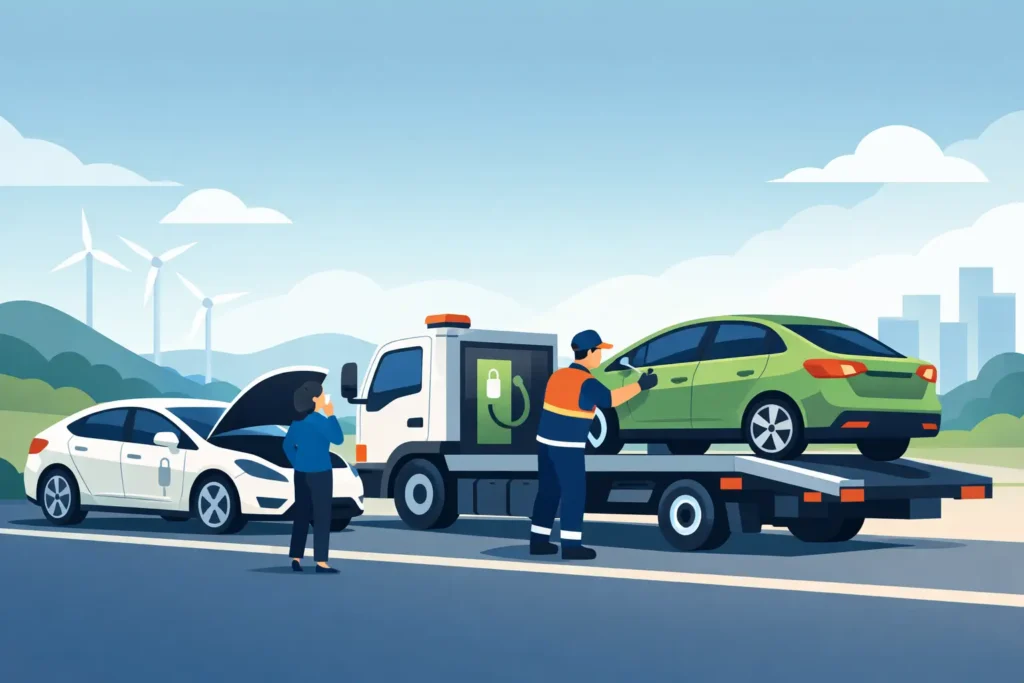
A reliable service should send a suitably equipped recovery vehicle rather than treating an EV as an ordinary tow job. For many non-running EVs, safe loading onto a flatbed or recovery lorry is the sensible option. The vehicle should be secured carefully and transported to your chosen destination, whether that is home, a garage, a dealer or a charging location where appropriate.
EV recovery service review: the details that matter
Fast arrival is a major part of any recovery review, particularly if you are stopped on a motorway hard shoulder, at the side of a busy A-road or in an unfamiliar area after dark. A provider should give realistic expectations, keep you updated if conditions change and focus on getting you out of danger first.
For drivers across Berkshire, South Oxfordshire, Reading, Hampshire and Surrey, local coverage makes a real difference. A recovery operator that regularly works around the M4, M25 and M3 understands the pressure of motorway callouts, restricted stopping areas and heavy traffic. That local knowledge can help avoid delays when every minute feels longer than it should.
Response time should never be a vague promise. Traffic, weather, road closures and your exact location all affect arrival, but a professional provider will be upfront. Ozzy’s Breakdown Recovery aims for a 30-45 minute response where road and traffic conditions allow, with 24/7 emergency assistance for EVs as well as petrol, diesel, hybrid, motorcycle and commercial vehicles.
Correct handling matters more than a quick tow
There is a common assumption that an EV with no charge can simply be towed to the nearest charger. That is not always safe or suitable. The manufacturer’s instructions for your model come first. Some vehicles have a dedicated tow mode, while others require specialist loading equipment or should not be towed with their driven wheels on the road.
A recovery team should assess the situation before moving the car. If your EV has suffered axle damage, wheel damage, suspension damage or accident impact, it may need more careful winching and loading. In these cases, the goal is controlled recovery, not rushing the vehicle onto a tow rope.
If there is visible battery damage, smoke, heat, a strong chemical smell or any concern following a serious collision, move away from the vehicle if it is safe to do so and contact emergency services. Do not attempt to inspect the high-voltage battery pack yourself. The recovery team needs to be told about these signs before arrival so they can plan the safest response.
Flat battery or charging fault?
Not every EV breakdown means the main battery is empty. A discharged 12V battery can prevent an electric car from starting, unlocking properly or selecting drive, even when the traction battery still has charge. In some cases, a suitable jump start can get the vehicle operating again. In others, recovery remains the safer option.
Charging faults can be equally frustrating. You may arrive at a public charger only to find the vehicle will not start charging, the connector will not release, or the charge point itself is unavailable. The fault may sit with the charger, cable, payment system or vehicle. If practical checks do not resolve it and you do not have enough range to continue, recovery transport prevents you from being left waiting on the roadside.
The best outcome depends on the circumstances. A small amount of available charge may be enough to reach a known working charger. If the car is displaying a serious warning or cannot be put safely into transport mode, it is usually better to arrange professional recovery rather than keep trying to move it.
Questions worth asking before you book
You do not need technical knowledge to arrange EV recovery, but a few direct questions can give you confidence that the service is right for the job. Ask whether the team can recover non-running electric vehicles, whether they use suitable loading equipment and whether they can transport your vehicle to a destination of your choice.
It is also sensible to confirm the estimated arrival time, price basis and any access issues at your location. A car park with a low height barrier, a narrow residential road or a live motorway situation can affect which recovery vehicle is sent. Giving accurate information at the start helps the team arrive prepared.
Have your vehicle make, model, registration and current location ready. If you can safely see the battery percentage and dashboard warning message, pass that on too. A photograph of the warning display may help when you are calling, but never put yourself at risk to get it.
What to do while waiting for EV recovery
Your first job is to stay safe. On a motorway or high-speed road, follow current roadside safety guidance and move behind a barrier if it is safe to leave the vehicle. Keep clear of moving traffic and do not stand between your car and the road.
On quieter roads, switch on your hazard lights and, where safe, position yourself away from the flow of traffic. If you are in a dangerous place, tell the recovery operator immediately. They can prioritise the callout and advise on the best next step.
Avoid repeatedly trying to restart the car, forcing a charging cable free or attempting makeshift towing. A vehicle that will not select drive may have a simple issue, but it may also need a controlled recovery procedure. Preserving the vehicle’s condition is worth more than saving a few minutes at the roadside.
A service review should come down to confidence
The strongest EV recovery service is not the one that uses the most technical language. It is the one that answers the phone, asks the right questions, turns up with suitable equipment and handles your vehicle with care. That is what matters when you are late, worried about range or stranded with passengers.
If your EV stops in Berkshire, South Oxfordshire or on the surrounding motorway network, do not gamble on an unsuitable tow. Call for 24/7 professional recovery, explain what the vehicle is doing and let an equipped team get you safely to the next place you need to be.