


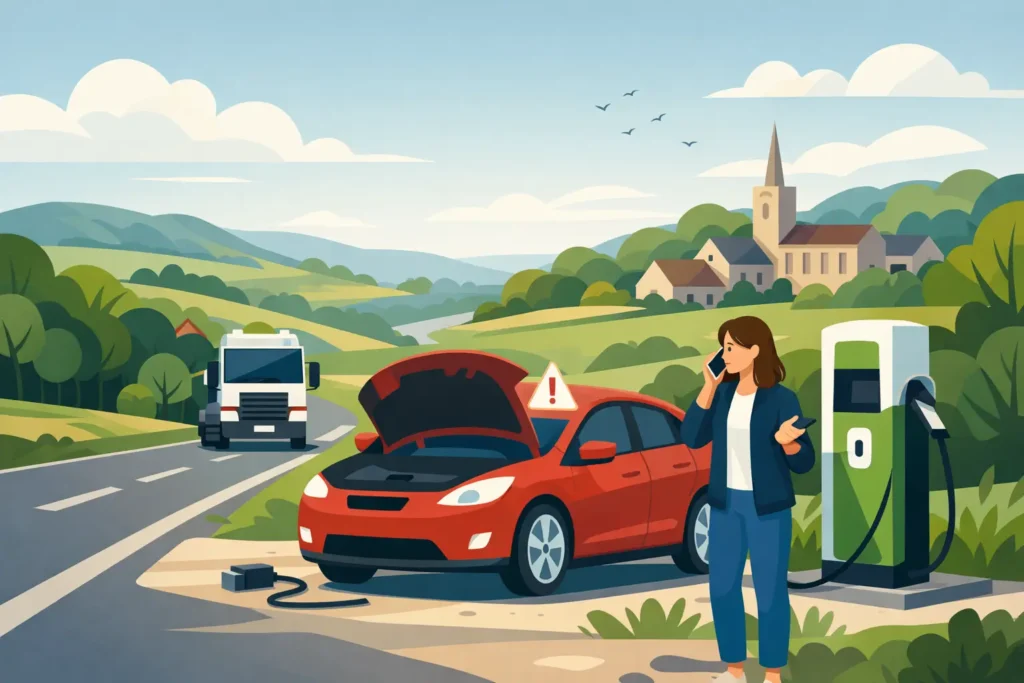
A flat traction battery on the M4, a warning light outside Reading or a charging fault in a supermarket car park can turn a normal journey into a stressful stop. This guide for stranded EV drivers explains what to do first, what not to do, and how to get your vehicle recovered without causing further damage.
The priority is not diagnosing the car at the roadside. It is getting you out of danger, protecting the vehicle, and arranging the right type of assistance quickly.
Put personal safety before the battery
If your EV loses power, steer to the safest available place as soon as you can. A lay-by, service area, car park or designated emergency area is far safer than trying to stretch the remaining range to the next charger. Turn on your hazard warning lights and keep a clear view of surrounding traffic.
On a motorway, the situation depends on where you stop. If you can reach an emergency area or leave the motorway safely, do so. If you are stopped on a hard shoulder and it is safe to leave the vehicle, exit by the left-hand door and wait well behind the safety barrier, away from the traffic flow. Keep passengers together, especially children.
If your vehicle is stopped in a live lane or cannot be moved to a safer place, stay in the vehicle with seat belts fastened, switch on hazards and call 999. Do not attempt to walk along a live motorway lane or try to push an EV to safety. Tell the emergency operator your exact location, direction of travel, nearby signs and the make and model of the car.
In a quieter location, such as a residential road or car park, make yourself visible and stand away from moving traffic. A vehicle that is low on charge may still be able to move a short distance, but only use that remaining energy to reach an obviously safer position. Do not gamble on reaching a charger that may be occupied, out of service or incompatible with your vehicle.
Work out what has actually stopped the journey
Not every EV that will not move has run out of charge. The dashboard message, charge level and condition of the vehicle help determine whether roadside assistance may be possible or whether recovery is the sensible option.
A very low state of charge, reduced power warning or turtle symbol may indicate that the traction battery is nearly empty. A charge-port error, repeated failed charging attempts or a message saying the car cannot be driven can point to a charging-system or high-voltage fault. A car that will not unlock, start or select drive despite plenty of battery range may have a weak 12-volt battery instead.
Take a photograph of any warning messages if it is safe to do so. Have the registration, vehicle make and model, your location and a brief description of the problem ready when you call for help. Clear information saves time and helps the recovery operator send the appropriate vehicle and equipment.
Do not keep switching the vehicle on and off in the hope that a serious warning will disappear. Likewise, do not repeatedly plug into a charger that has already failed unless the charging provider has confirmed a simple issue at their end. A few sensible checks are enough. Once the car is immobile or displays a serious fault, the focus should move to safe recovery.
Do not treat an EV like a conventional breakdown
Electric cars can be heavier than equivalent petrol or diesel vehicles, and their drivetrains have specific recovery requirements. That matters when a car is out of charge, locked in park or has suffered accident damage.
Many EVs must not be towed with the driven wheels on the road. Doing so can damage the electric motor, reduction gear or regenerative braking system. Some models have a transport mode or a specific method for releasing park, while others need wheel skates, dollies or a flatbed recovery vehicle. The correct approach depends on the manufacturer’s instructions and the condition of the vehicle.
For that reason, do not accept an improvised tow from a passing motorist. A tow rope may look like a quick answer, but it can create a road safety risk and lead to expensive drivetrain damage. It is especially unsuitable on busy routes such as the M25, M4 and M3, where traffic speed and limited stopping space make proper recovery essential.
A trained recovery team will assess whether the EV can be loaded normally, whether its wheels need supporting, and whether accident damage or a locked transmission changes the plan. If the car has been involved in a collision, is leaking fluid, smoking, hot underneath or showing a battery-damage warning, tell the operator immediately. Keep clear of the vehicle and follow emergency-service instructions where required.
What to tell an EV recovery operator
A quick, accurate call helps get the right help to you first time. Explain whether the vehicle has simply run out of charge, has a warning message, has been in an accident, or will not engage drive. Mention if it is parked underground, in a tight multi-storey car park, on a narrow lane or in a motorway emergency area.
It is also useful to confirm whether the car is accessible, whether you have the key, and whether it can be placed in neutral or transport mode. You do not need to know the technical detail. Just say what the dashboard is showing and what happens when you try to move the vehicle.
For urgent call-outs across Berkshire, South Oxfordshire and surrounding motorway routes, Ozzy’s Breakdown Recovery can arrange EV-compatible recovery day or night. A professional operator will prioritise your location and vehicle condition rather than treating an electric car as a standard tow.
Decide between mobile charging and recovery
Mobile charging can sound like the ideal fix, but it is not always the fastest or best option. It may be practical when the EV is safely parked, the vehicle has no fault warnings, and a small amount of charge will get you to a reliable nearby charging point. It can also depend on the vehicle’s connector, available equipment and access to the parking location.
Recovery is usually the better choice when you are stopped on a motorway, in an unsafe roadside position, at zero per cent charge, or when there is any sign of a fault. It is also sensible if the nearest charger is uncertain, your battery has been repeatedly depleted, or you need to get home, to a garage or to a known working charge point without further disruption.
There is a trade-off. A mobile top-up may get you moving sooner in the right circumstances, while recovery gives greater certainty when the situation is complicated. Do not let the fear of inconvenience persuade you to keep attempting a journey with an unreliable vehicle. One safe recovery is often better than several failed charging stops.
Protect the battery while you wait
Once you are safely stopped, avoid draining the 12-volt battery unnecessarily. Switch off non-essential electrical items, such as heated seats, high-power audio and unnecessary interior lighting. In cold weather, balance comfort with preserving power, particularly if you are waiting for help in a safe location.
Do not try to open, disconnect or inspect orange high-voltage cables. These systems should only be handled by suitably trained technicians. If the car is damaged, smells unusual, emits smoke or displays a battery temperature warning, move away if safe and call the emergency services. Never pour water on a suspected battery fire or attempt a roadside repair.
If your EV is parked securely and you are waiting for recovery, keep the key with you and make sure the recovery team knows if the vehicle may lock itself automatically. Have your charging cable available if you need to move on after a mobile charge, but do not leave cables trailing where they could create a hazard.
Reduce the chance of being stranded next time
EV range is affected by more than the percentage shown on the dashboard. Cold weather, motorway speed, strong winds, heavy loads, tyre condition and towing can all reduce how far the car will travel. The displayed estimate is useful, but it is still an estimate.
Before a longer journey, plan a main charging stop and a realistic backup. Check that the charger type suits your car and avoid arriving with no margin for a queue or an out-of-order unit. On long motorway runs, charging a little earlier is usually less stressful than chasing the final few miles of range.
Keep your charging cards or apps ready, carry the correct cable where your vehicle needs one, and make sure your breakdown details are easy to find. For business drivers, fleet managers should make sure staff know who to call, what vehicle information to provide and that an EV must be recovered using suitable equipment.
A stranded EV is frustrating, but it does not have to become a dangerous or costly ordeal. Get to the safest place you can, give clear information, and let a properly equipped recovery team take over. The quickest route back on the road is often the one that starts with a calm call for the right help.