


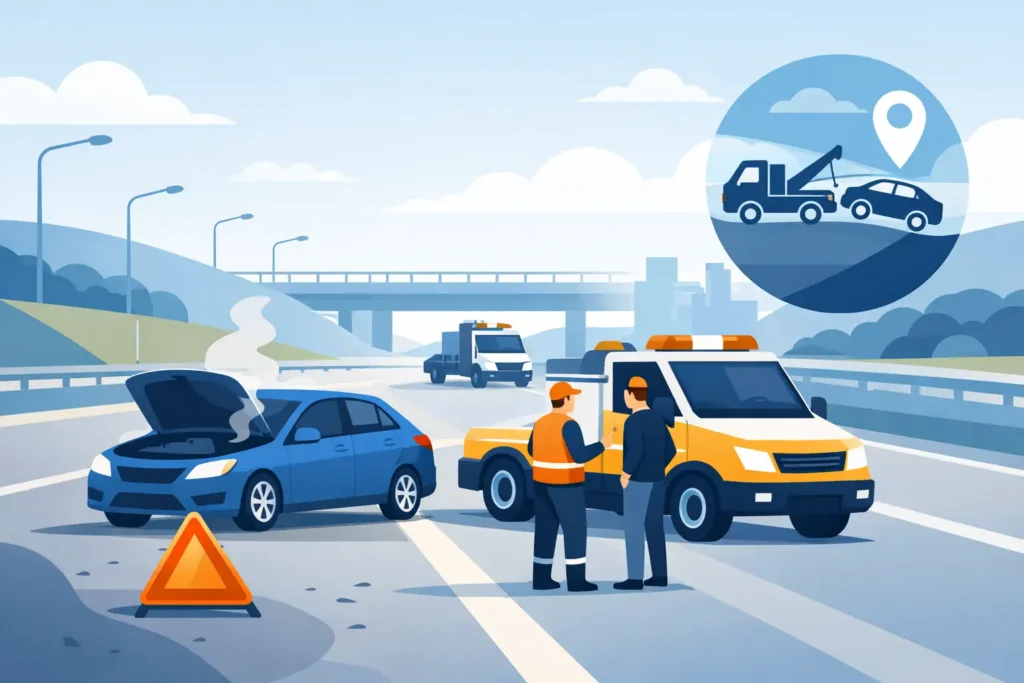
A motorway breakdown is never convenient, but it becomes far less stressful when you know what to do first. This guide to motorway breakdown help explains how to protect yourself, communicate your location clearly and arrange the right recovery service without losing time on busy routes such as the M4, M25 and M3.
The priority is always people, not the vehicle. A car, van, motorcycle or EV can be recovered. Your job in the first few minutes is to get yourself and any passengers out of immediate danger, then call for professional help.
What to do when you break down on a motorway
As soon as you notice a serious problem, reduce speed smoothly and put your hazard warning lights on. Avoid harsh braking or sudden steering, particularly if you have a tyre issue, loss of power or warning lights appearing on the dashboard. Move as far left as you safely can.
On a conventional motorway, aim for the hard shoulder. Stop as far to the left as possible, keep your wheels turned left, and leave your hazard lights on. If it is dark or visibility is poor, use your sidelights as well.
On a smart motorway, use a designated emergency area if you can reach one safely. These areas are designed to give you space away from live traffic and usually have an emergency telephone. Do not attempt to continue driving if the vehicle is unsafe, overheating badly, losing oil, has a damaged wheel or has lost steering control.
If you can leave the vehicle safely from the left-hand side, do so and wait behind the safety barrier, well away from moving traffic. Take passengers with you where it is safe to do that. Keep children close and do not let anyone stand between the vehicle and traffic.
There are occasions where leaving the vehicle is not safe, especially if you are stopped in a live lane with traffic passing close by. In that situation, keep seat belts fastened, switch on hazard lights and call 999 immediately. Use the motorway emergency SOS system where available. Follow the instructions given by emergency services.
Guide to motorway breakdown help: making the right call
Once everyone is safe, contact a recovery provider that can respond to your location and vehicle type. Motorway recovery is not simply a matter of sending any tow vehicle. The recovery team needs to know whether you have a car, motorcycle, van, EV or commercial vehicle, what has happened and whether the vehicle can roll and steer.
When you call, give the clearest location information you can. Look for the motorway name, direction of travel, nearest junction number, a marker post reference or the number shown in an emergency area. A marker post is often the quickest way for a recovery operator to pinpoint where you are. If you have passed a junction, say so. If you are travelling towards Reading, London, Heathrow, Basingstoke or another major destination, include that too.
Explain the fault in plain terms. For example, say that the engine has cut out, the tyre has blown, the battery is flat, there has been an accident, or the vehicle has a warning message and will not restart. Mention any visible damage, leaking fluids, locked wheels or axle damage. These details help ensure the right recovery vehicle, equipment and operator are sent first time.
For urgent assistance across Berkshire, South Oxfordshire and surrounding motorway routes, Ozzy’s Breakdown Recovery provides 24/7 roadside assistance and vehicle recovery. A typical response can be 30 to 45 minutes, subject to traffic conditions, road closures, police incidents and your exact location.
Tell the recovery team about passengers and the vehicle
A good callout starts with accurate information. Tell the operator how many people are with you, whether anyone needs additional support, and whether you have a safe place to wait. If you are carrying animals, tools, business stock or bulky items, mention this too.
The vehicle details matter just as much. Provide the registration, make and model where possible. For vans and light commercial vehicles, describe any load that may affect access or safe transport. If you drive an electric vehicle, say whether it has charge, whether it can be selected into neutral and whether it has been involved in an impact. EV recovery requires appropriate handling, particularly where there may be battery or underbody damage.
Why motorway recovery needs professional equipment
A motorway is not the place for improvised repairs or a friend attempting a roadside tow. High traffic speeds, narrow refuge areas and poor weather can turn a manageable fault into a dangerous situation very quickly.
Professional recovery operators use dedicated vehicles, securing equipment and correct loading methods to move vehicles safely. This is particularly valuable for non-runners, automatic vehicles, motorcycles, lowered cars and vehicles with wheel, suspension or axle damage. Pulling or towing a damaged vehicle incorrectly can cause further damage and may leave it unsafe to transport.
The right method depends on the fault. A flat battery may only need a jump start if the vehicle is otherwise safe and reliable to continue. A puncture may be resolved with a spare wheel, but not if the tyre damage is severe, the wheel is damaged or you are in an unsafe location. An overheating engine, gearbox problem or major warning light usually calls for recovery rather than hoping the vehicle will make it to the next junction.
For businesses, that decision is often about downtime as much as distance. A stranded van can delay jobs, affect customers and leave tools or goods exposed. Fast, dependable commercial vehicle recovery helps get the vehicle, driver and workload back under control.
What not to do at the roadside
The safest choice can feel frustrating when you are late, travelling with family or trying to get to work. However, a few actions are best avoided on any motorway or high-speed dual carriageway:
- Do not try to repair a tyre, check under the bonnet or inspect damage beside live traffic.
- Do not walk along the motorway to find assistance or cross carriageways.
- Do not stand in front of, behind or on the traffic side of your vehicle.
- Do not accept unverified help from a passing vehicle or agree to an unsafe tow.
- Do not keep driving merely to reach a preferred garage if the vehicle feels unsafe or displays serious fault warnings.
If you are in a safe emergency area or behind a barrier, stay visible to the recovery team and keep your phone available. Conserve battery power if your charge is low, but do not switch it off before the operator has your contact details and location.
Choosing between roadside repair and recovery
Not every breakdown needs a full recovery, and an honest assessment saves time. A simple jump start, fuel delivery issue or wheel change may get you moving again. That only makes sense when the vehicle is safe to drive and the fault is unlikely to return straight away.
Recovery is the better option when the cause is uncertain, when warning lights remain on, or when the vehicle has suffered a collision or mechanical failure. It is also sensible if you are travelling a long distance, driving at night or carrying passengers who cannot safely wait for repeated roadside attempts.
Ask the recovery provider where the vehicle can be taken. You may need transport to a local garage, a home address, a dealership or a secure location. The best destination depends on the fault, the time of day and whether the vehicle is under warranty. Clear communication at the start prevents surprises once the vehicle is loaded.
Prepare before your next motorway journey
You cannot prevent every breakdown, but a small amount of preparation makes a difficult situation easier to manage. Keep your phone charged before a longer journey and carry a charging cable or power bank. Check tyre condition, fuel or battery range, fluid levels and dashboard warnings before setting off.
It also helps to keep a hi-vis jacket, warm layer, drinking water and any essential medication within easy reach. Do not store everything under heavy luggage if you would need to access it in an emergency. For EV drivers, plan charging stops with enough range in reserve for diversions, queues and cold-weather reductions.
When a vehicle stops unexpectedly on the motorway, take the safe option early. Get to the left if you can, protect your passengers, share an accurate location and call a professional recovery team. A prompt, properly equipped response gives you the best chance of getting off the road safely and back to your day with minimal disruption.