


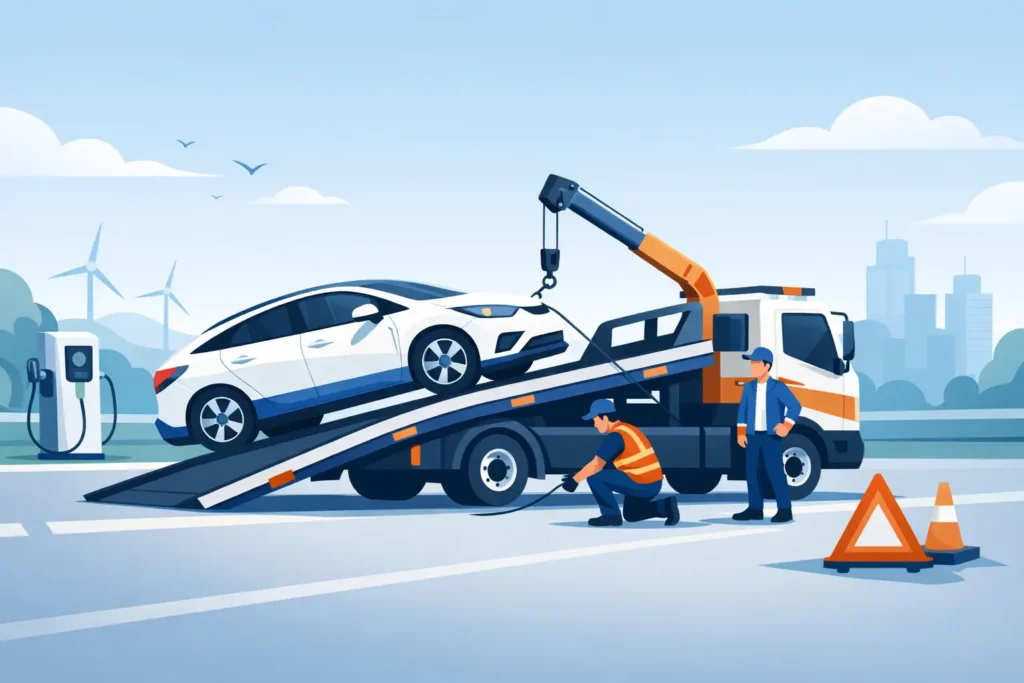
An EV stopped on the hard shoulder is not just another breakdown with a different badge on the bonnet. Electric vehicle recovery needs the right handling, the right equipment and a recovery team that understands what can and cannot be done at the roadside. If the vehicle has lost drive, suffered battery issues or been involved in an accident, guessing is the last thing you want.
For most drivers, the main concern is simple. You need help quickly, you need clear advice, and you need confidence that your car will be moved without causing further damage. That matters even more with electric vehicles, where towing methods, isolation procedures and loading techniques are not always the same as with petrol or diesel cars.
What makes electric vehicle recovery different?
The biggest difference is that many EVs should not be towed with their wheels on the road in the same way as a conventional vehicle. Depending on the model, doing so can damage the motor, drivetrain or regenerative braking system. In some cases, even moving the vehicle a short distance incorrectly can lead to expensive repairs.
There is also the high-voltage system to consider. That does not mean every EV breakdown is dangerous, but it does mean recovery has to be approached properly. If a vehicle has warning lights showing, has shut down unexpectedly, has suffered impact damage or there are concerns around the battery pack, the recovery process needs to be cautious and methodical.
This is why a dedicated recovery vehicle is often the safest option. A proper lift and load, or full vehicle transport, reduces the risk of drivetrain damage and gives better control over how the vehicle is secured. It is also the better choice for non-runners, accident-damaged EVs and cars that are stuck in park or have electronic faults.
Common reasons drivers need electric vehicle recovery
Running out of charge is the one people talk about most, but it is far from the only reason an EV ends up stranded. Breakdown callouts often involve 12V battery failure, charging faults, damaged tyres, collision damage, software-related shutdowns or vehicles that simply will not select drive.
A flat 12V battery catches a lot of owners out. Even though the main traction battery may still hold charge, the car can become completely unresponsive if the low-voltage battery fails. Doors may not unlock normally, systems may not boot up, and the vehicle may not move at all.
Charging issues are another common problem. Sometimes the vehicle will not accept a charge. Sometimes a public charger fails mid-session, leaving the driver with less range than expected. In other cases, a fault code puts the car into reduced power mode or stops charging altogether.
Then there are the everyday problems that affect any vehicle on the road. Punctures, suspension damage, accident recovery and mechanical faults still happen. The difference is that with an EV, the recovery method needs to match the vehicle rather than relying on standard towing habits.
Why the recovery method matters
When drivers search for help, they often focus on response time first. That is understandable when you are stuck on the M4 at night or stranded in a car park with no charge left. But with EVs, speed and correct handling have to come together.
A professional operator should first establish the make and model, the nature of the fault, whether the vehicle can roll freely and whether there has been any collision or underbody damage. Those details shape the safest plan. Some EVs can be winched carefully onto a flatbed. Others may need wheel skates or extra precautions if the wheels are locked or the electronic systems have failed.
This is also where experience counts. Recovery is not just about moving a vehicle from A to B. It is about avoiding further stress for the customer and avoiding further damage to the car. If the operator on the phone and the driver on scene understand EV-specific handling, the whole job becomes quicker, calmer and safer.
Electric vehicle recovery at the roadside
Not every EV problem ends with a tow. In some situations, a roadside fix may still be possible. If the issue is a flat 12V battery, a safe jump start may get the vehicle live again. If there is a minor issue with access, tyre inflation or a simple reset, the driver may be able to continue the journey.
That said, roadside solutions depend on the fault. A traction battery problem, charging system error or drivetrain issue is rarely something to gamble on. If warning messages persist or the car will not drive normally, recovery to a home address, workshop or main dealer is usually the sensible next step.
Drivers are often tempted to keep trying, especially if the vehicle still powers up. That can be a mistake. Repeated attempts to drive a faulted EV can leave it in a worse condition or stop it in a more dangerous place. A controlled recovery early on is often the cheaper option.
Accident recovery for electric vehicles
Accident recovery adds another layer of care. If an EV has been hit underneath, struck a kerb hard or been involved in a more serious collision, the battery pack may need special attention even if there is no obvious external damage. Modern EVs are built with strong protection systems, but impact damage should never be brushed off.
A damaged EV should be loaded and transported with care, not dragged or improvised into position. If the car will not power down properly, if there are warning alerts linked to the high-voltage system, or if there is visible structural damage, the recovery team should treat the vehicle accordingly and move it without unnecessary risk.
For drivers, the key point is simple. After an accident, do not assume an electric vehicle can be recovered like any other car. Tell the recovery operator exactly what happened, whether the vehicle is leaking, smoking, showing warning lights or refusing to move. The more accurate the information, the better the response.
Choosing the right electric vehicle recovery service
If you own or drive an EV regularly, it is worth knowing what good recovery looks like before you need it. A proper service should offer 24/7 availability, clear communication and the right transport setup for electric vehicles, not just a basic tow rope solution.
Local coverage matters as well. If you break down in Berkshire, South Oxfordshire or on routes such as the M25, M4 or M3, you want a team that already operates in those areas and can reach you quickly. Long waits on a motorway shoulder or in an exposed roadside lay-by are not just frustrating. They increase risk and turn a manageable problem into a much worse one.
It also helps to choose a service used to dealing with different vehicle types. Private EV owners, company cars, electric vans and hybrid vehicles all present slightly different practical issues. A recovery provider that handles everything from everyday breakdowns to non-runners and accident damage is far more likely to make the right call under pressure.
That is why specialist local operators such as Ozzy’s Breakdown Recovery are increasingly the first call for EV drivers who need fast, no-fuss help. The priority is not jargon. It is getting to you quickly, loading the vehicle properly and taking it where it needs to go without adding to the problem.
What to do while waiting for recovery
If your EV breaks down, your first job is safety. Move to a safe place if you can. If you are on a motorway or fast road and the vehicle cannot be moved, follow breakdown safety guidance, switch on hazard lights and contact recovery straight away. Do not keep trying to restart or move the vehicle if it is clearly not responding properly.
When you call, be ready to give your exact location, vehicle make and model, registration, battery charge level if known, and a clear description of what happened. Mention any warning messages, accident damage, whether the car will select neutral and whether it can roll. These details help the recovery team arrive prepared.
If you are carrying a charging cable, personal belongings or business equipment, make a note of what needs to be retrieved before transport. Once the vehicle is loaded, access can be more limited. A few clear minutes on the phone can save a lot of hassle later.
Electric vehicles are reliable for day-to-day driving, but when they do stop, they need the right response. Fast attendance matters, but proper handling matters just as much. If you ever need electric vehicle recovery, choose a service that treats your EV like the specialist vehicle it is and gets you out of trouble without wasting time.