


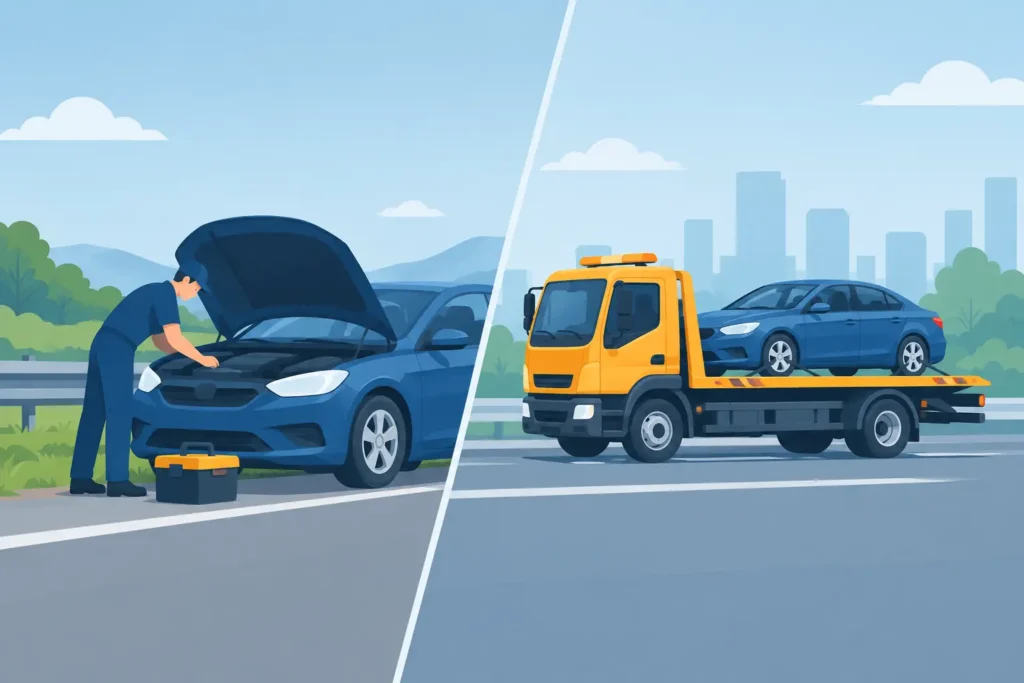
A warning light on the M4, a flat battery outside Reading, or a van that will not restart before a delivery creates the same immediate question: roadside repair versus vehicle transport – which gets you moving with the least risk and delay? The right answer depends on the fault, where you are stopped, and whether the vehicle can be made safe to drive. What matters first is protecting you, your passengers and other road users.
What roadside repair is designed to solve
Roadside repair is the practical answer when the fault is straightforward, the vehicle is in a safe place, and a quick fix will leave it roadworthy. Common examples include a flat battery requiring a jump start, a puncture where a safe spare or approved repair is available, an empty fuel tank, or a minor issue that can be diagnosed and resolved without dismantling the vehicle.
The attraction is obvious. A successful repair can get you back on the road without the time and cost of a recovery journey. For a driver on the way to work, a family collecting children, or a local business with a vehicle needed that day, that can make a major difference.
However, a quick repair should never mean taking a chance. A vehicle that starts is not automatically safe to continue driving. If there is an engine management warning, overheating, brake concern, steering problem, fluid leak, damaged tyre, or repeated loss of power, driving on can turn a manageable fault into expensive damage or a dangerous situation.
When a repair at the roadside makes sense
A roadside solution is usually suitable where the problem has a clear cause and the vehicle can be checked before it leaves. A flat battery caused by lights being left on is different from a battery that repeatedly fails to hold charge. Likewise, a tyre change is only appropriate when the remaining tyres, wheel and suspension are sound.
Location matters just as much as the mechanical issue. A quiet residential road or a safe car park may allow time for a technician to assess the vehicle. On the hard shoulder, a live lane, a narrow country road or a busy junction, reducing the time spent exposed to traffic is often the priority. On motorways such as the M25, M4 and M3, a recovery plan may be the safer choice even for a fault that appears minor.
Roadside repair versus vehicle transport: the key difference
Vehicle transport means moving your car, van, motorcycle or EV on dedicated recovery equipment rather than asking it to travel under its own power. It is not simply a last resort. It is the correct service when the condition of the vehicle is uncertain, the damage is visible, or the journey itself could cause further harm.
Transport is particularly useful after a collision, when an axle, wheel, suspension component or steering part is damaged. It is also the safer route for non-runners, vehicles with gearbox or clutch problems, serious engine faults, and electric vehicles that cannot be driven or charged safely at the roadside. Motorcycles need the same care: an issue that leaves a bike unstable, leaking or unable to start should be handled with suitable motorcycle recovery equipment.
For commercial drivers, transport can protect more than the vehicle. Continuing with an unreliable van may mean another breakdown, missed jobs, unhappy customers and lost working hours. Getting the vehicle to a trusted garage in one controlled move is often the fastest way to restore service.
Signs that transport is the safer option
Choose professional vehicle transport when there is collision damage, a wheel or axle issue, overheating, smoke, a significant leak, brake or steering trouble, or a fault that returns immediately after a restart. The same applies if the vehicle is stuck, cannot select gears, has no safe spare tyre, or is displaying serious EV warnings.
Do not rely on a hopeful restart after impact or mechanical failure. A car can appear intact while vital components underneath have been damaged. Attempting to drive it may compromise handling, damage the drivetrain, or leave you stranded again somewhere less safe.
Safety comes before the quickest-looking fix
When a breakdown happens, it is natural to focus on getting away quickly. The safer decision is often to stop, assess the situation and let a trained recovery professional decide whether an on-site repair is sensible. That is especially true at night, in heavy rain, or on fast roads where visibility and passing traffic increase the risk.
If you can do so safely, move away from traffic and switch on your hazard lights. On a motorway, follow the relevant safety guidance for your position and avoid attempting repairs beside live traffic. Do not stand between your vehicle and passing vehicles, and do not try to inspect underneath a vehicle at the roadside.
While waiting for help, keep these essentials in mind:
- Put yourself and passengers in the safest available place, away from moving traffic.
- Share your exact location, direction of travel and any nearby junction, marker or landmark.
- Explain the symptoms clearly, including warning lights, noises, collision damage or leaks.
- Tell the recovery provider whether you are in a car, van, motorcycle or electric vehicle.
Accurate information helps the right recovery vehicle and equipment arrive first time. It also allows the operator to plan for specialist needs, such as a low-clearance vehicle, axle damage, a locked wheel or an EV that must not be towed conventionally.
Cost, time and the risk of further damage
Many drivers assume roadside repair will always be cheaper and transport will always take longer. Often that is true, but not always. A simple jump start can be the most efficient outcome. Yet paying for a temporary roadside fix, only to need recovery later after the vehicle fails again, can cost more in time and money.
Transport may be the better-value option if the fault needs garage diagnostics, parts, ramp access or specialist tools. It avoids forcing a vehicle through a journey it is not fit to make. It can also prevent secondary damage, such as an overheated engine suffering further harm or a damaged wheel affecting suspension and steering components.
There is also the practical question of destination. If a repair is not possible, you may need the vehicle taken home, to a workplace, to a garage, or to another safe location. A clear recovery plan means you are not left trying to arrange a second journey while already dealing with a breakdown.
The right service for cars, vans, motorcycles and EVs
Different vehicles fail in different ways, and recovery should match the vehicle rather than use a one-size-fits-all approach. A family car with a flat battery may only need a professional jump start and a quick check. A loaded van with a drivetrain fault requires safe, capable transport that protects the vehicle and minimises business downtime.
Motorcycle recovery needs secure handling to prevent damage in transit. Vehicles with accident damage, a broken axle or wheels that will not turn may need specialist loading. Electric vehicle recovery also calls for the correct knowledge and equipment, particularly when the issue involves the charging system, battery warnings or an immobilised vehicle.
That is why a proper assessment matters. The goal is not to insist on transport when a simple roadside repair will do. It is to give you the quickest safe solution based on the vehicle in front of us, the fault reported and the road conditions around it.
Make the call before a small fault becomes a bigger problem
If your vehicle is safe, a roadside repair may get your day back on track quickly. If there is any doubt about its condition, professional transport protects you from further trouble and gets the vehicle where it needs to be. Ozzy’s Breakdown Recovery provides 24/7 roadside assistance and vehicle recovery across Berkshire, South Oxfordshire and surrounding motorway routes, with the right approach for everyday faults and more complex recoveries.
A breakdown is stressful enough without guessing whether your vehicle should be driven. Give a clear account of what has happened, stay somewhere safe, and let an experienced recovery team make the call that keeps your journey, vehicle and plans protected.