


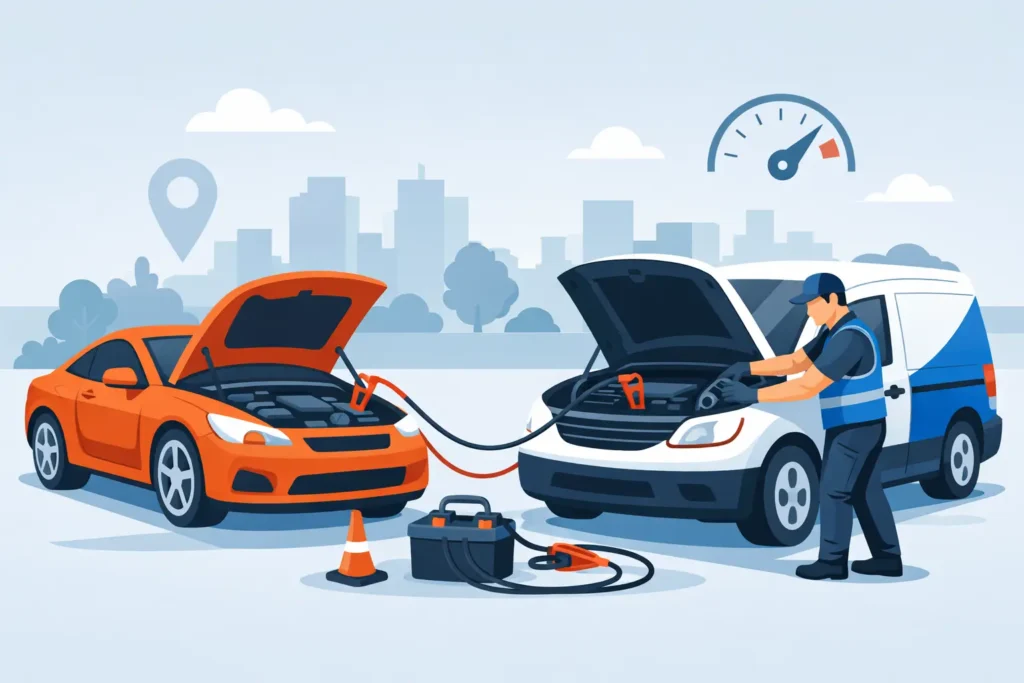
It usually happens when you are already late. You turn the key, the dashboard flickers, and the engine will not fire. A reliable car jump start service is not a nice extra at that point – it is the quickest way to get moving again without adding more stress to an already bad day.
When your battery goes flat at home, in a work car park, outside the school gates or on the hard shoulder, speed matters. So does turning up with the right kit and knowing whether a jump start is actually safe for the vehicle. That is why many drivers would rather call for proper roadside help than gamble with cables from a passing motorist.
When a car jump start service is the right call
A flat battery is one of the most common reasons a car will not start, but it is not the only one. If the engine is slow to turn over, the lights are dim, or you hear rapid clicking when you try the ignition, the battery is often the problem. In those cases, a jump start may be enough to get you back on the road.
There are times, though, when the battery is only part of the story. If the car cuts out repeatedly, if there is obvious damage after an accident, or if warning lights suggest a charging fault, simply forcing the engine back to life may not solve much. A proper roadside technician will check what is happening first, then decide whether a jump start, battery support or full recovery is the safer option.
That matters more with modern vehicles than many people realise. Newer cars carry a lot of sensitive electronics, and some start-stop systems, hybrids and electric vehicles need a different approach. The quick fix you might have used years ago on an older car does not always suit what is parked on your drive now.
Why drivers call for professional jump starts
The obvious reason is convenience. If you are stranded, you want someone there quickly who can sort the issue without turning it into a bigger one. But convenience is only part of it.
Safety is the bigger point. Incorrect jump starting can damage electrical systems, blow fuses or create sparks in the wrong place. That risk goes up in poor weather, on busy roads or when drivers are trying to work in tight spaces with no proper equipment. A professional service arrives prepared, connects things correctly and works with the surroundings in mind.
There is also the question of what happens next. A battery can go flat because a light was left on, but it can also fail because it is old, the alternator is not charging properly, or the car has been standing too long. A good roadside response does more than get the engine running. It helps you understand whether you can carry on with confidence or whether recovery is the smarter choice.
For motorists across Berkshire, South Oxfordshire and the main motorway routes nearby, that difference is important. Breaking down on the M4, M3 or M25 is very different from being stuck on your driveway. You need clear communication, a realistic arrival time and a team that treats the situation with proper urgency.
What to expect from a fast car jump start service
First, you should expect a quick response and a straightforward phone call. In a breakdown, nobody wants a long process. You need to explain where you are, what the vehicle is doing, and whether you are in a safe location. From there, the focus should be on getting help moving without delay.
Once on scene, the technician should confirm the fault before attempting a jump start. If the battery is flat, the process is simple enough with the right equipment. If the issue points elsewhere, you should be told plainly. That honesty matters. There is no value in pretending a jump start has fixed the problem if the car is likely to stop again ten minutes later.
You should also expect the vehicle to be handled properly. That includes cars, vans, motorcycles and, where suitable, newer vehicle types that need more care around electronics and recovery methods. A service-first operator does not just focus on getting to you fast. They focus on getting the job done safely.
Car jump start service for homes, workplaces and roadsides
Flat batteries do not keep office hours. Early mornings are common, especially in winter, when cold weather exposes a weak battery. Company vehicles left standing over a weekend can be just as vulnerable, and so can family cars used for short local trips that never really give the battery time to recharge.
That is why a 24/7 service matters. If your car will not start before work, if your van is off the road before a delivery run, or if your vehicle dies late at night after a long shift, waiting until normal business hours is not always an option. Downtime costs time, money and patience.
For private motorists, quick attendance means less disruption and less worry. For businesses, especially those running light commercial vehicles, it can mean the difference between keeping the day on track and losing jobs. That is one reason firms in the area often rely on roadside teams that can deal with both simple battery failures and larger recovery needs without passing the problem elsewhere.
Not every non-start is a battery problem
This is where experience earns its keep. Plenty of drivers assume a flat battery because the car will not start, but the real fault may be with the starter motor, alternator, ignition system or another electrical issue. In colder months, old batteries fail more often, but that does not mean every no-start is solved with a boost.
There are also situations where attempting a jump start is the wrong call. If the battery casing is damaged, if there is a burning smell, if the vehicle has been in a collision, or if the car has specialist requirements, roadside recovery may be safer than trying to restart it there and then.
The practical value of a professional service is that you do not need to make that judgement alone while stressed at the side of the road. The job is to assess, act and give you the quickest safe route forward.
Local response makes a real difference
In breakdown work, local coverage is not just a marketing line. It affects how quickly help reaches you, how well the driver knows the roads, and how easily support can be delivered on awkward routes, in residential streets or on busy motorway corridors.
A provider covering Berkshire, Reading, South Oxfordshire, Hampshire, Surrey and surrounding routes can often react faster than a distant national dispatch model. That local presence also helps with realistic arrival times. If you are stranded, vague promises are no use. You want to know that somebody is on the way and that your call is being handled by people who know the area.
Ozzy’s Breakdown Recovery is built around that kind of response – practical, round the clock and focused on getting drivers out of trouble fast. Whether the problem is a straightforward flat battery or something that needs full recovery, the aim stays the same: reduce the delay, protect the vehicle and get you looked after properly.
How to help while you wait
If you have called for assistance, the best step is usually to keep yourself safe rather than trying repeated starts. Turn on your hazard lights if needed, move to a safer spot if the vehicle can still roll and it is safe to do so, and keep your phone nearby in case the recovery driver needs to confirm your location.
If you are on a motorway or major A-road, follow normal breakdown safety advice and keep well away from moving traffic. If you are at home or at work, make sure the vehicle is accessible and any locking wheel nuts or keys are easy to hand if further help is needed.
The main thing is not to turn a flat battery into a bigger problem by guessing. Repeated attempts to start a failing vehicle can drain what little power is left and sometimes make diagnosis harder when help arrives.
A dead battery can ruin a morning in seconds, but it does not need to ruin the rest of your day. The right roadside team will treat it like what it is – an urgent problem that needs a fast, clear and professional fix.