


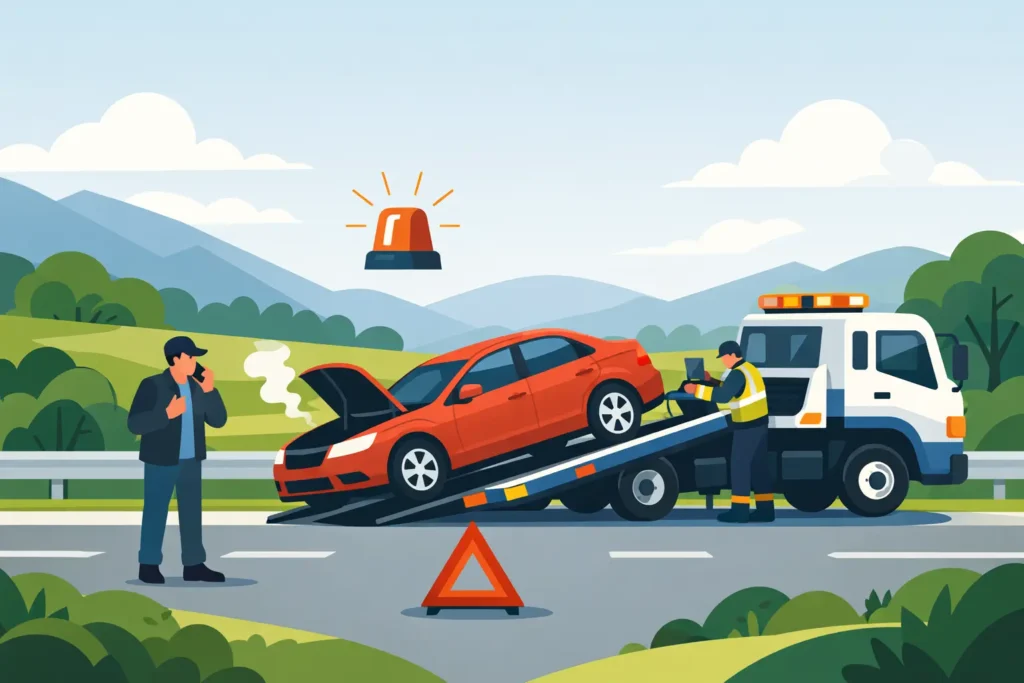
A breakdown on the M4 near Reading, a flat battery outside home in Berkshire, or an accident on a country lane can turn into a stressful situation quickly. This Berkshire emergency towing guide gives you the practical steps to stay safe, explain what you need, and get the right recovery vehicle moving towards you without delay.
The priority is never to diagnose the fault at the roadside. Get yourself and any passengers out of danger first, then arrange professional help that can recover your vehicle properly.
First steps when your vehicle stops
Switch on your hazard warning lights as soon as you realise there is a problem. If the vehicle can still move safely, steer it away from traffic and stop somewhere with space around you, such as a lay-by, car park, side road or safe verge. Avoid stopping on bends, blind summits or narrow stretches where other drivers may not see you in time.
Put the handbrake on, select park or neutral as appropriate, and keep passengers away from the road. At night, poor weather or on a fast road, visibility matters just as much as the mechanical fault. Wear a high-visibility jacket if you have one, but do not put yourself at risk trying to retrieve equipment from the boot in live traffic.
If there has been a collision, check for injuries and call 999 immediately where anyone is hurt, there is danger from traffic, fuel is leaking, a vehicle is blocking the carriageway, or you feel unsafe. Recovery comes after the emergency services when lives or road safety are at risk.
Berkshire emergency towing guide for motorways
Berkshire drivers regularly use fast routes including the M4, M25 and M3, where a stopped vehicle needs a different response from a minor breakdown on a residential street. Do not attempt roadside repairs beside high-speed traffic, and never rely on another motorist to tow you from a motorway.
If possible, leave at the next junction or pull into a service area before the fault gets worse. If you must stop, aim for a hard shoulder or emergency area where available. Stop as far left as you can, turn on hazards, and use the emergency SOS phone if one is nearby. Where it is safe to do so, leave the vehicle by the left-hand door and wait behind a safety barrier, well away from moving traffic.
Smart motorway conditions depend on where you have stopped. If your vehicle is stranded in a live lane and you cannot reach a place of safety, keep seatbelts on, switch on your hazards and call 999. Do not get out into live traffic unless there is an immediate threat such as fire. Give the operator your motorway, direction of travel, junction number or the nearest marker post.
A recovery provider needs clear location details to reach you quickly. “Near Reading” is useful, but “westbound M4, just after Junction 11” is far better. On country roads, name the village, road number, nearest landmark and whether the vehicle is blocking the road.
What to tell the recovery operator
A short, accurate call helps the right vehicle arrive first time. Explain the make, model, registration and whether your vehicle is a car, motorcycle, van or light commercial vehicle. State what happened: it will not start, has a puncture, overheated, has warning lights, has been in an accident, or has suffered axle or wheel damage.
Also say whether the wheels turn, whether the steering is locked, and if the vehicle is in a difficult position such as underground parking, a narrow lane or a busy motorway. These details affect the equipment needed. A simple tow may not be suitable for a vehicle with suspension damage, locked wheels, a broken axle or an automatic gearbox fault. In those cases, a proper recovery lorry or specialist lifting equipment protects the vehicle from further damage.
Tell the operator where you want the vehicle taken. That may be your home, a local garage, a dealership, a workplace or another secure location. If it is outside normal opening hours, consider whether your chosen garage can accept the vehicle. A good recovery plan avoids paying for a second move the following morning.
Not every breakdown needs the same response
A jump start can be the quickest answer when a battery has gone flat, but it is not always the right one. If the battery warning light was on before the vehicle stopped, or the vehicle repeatedly loses charge, it may need recovery rather than another start. Driving away with an alternator fault can leave you stranded again minutes later.
Punctures are also case by case. If you have a usable spare, are stopped somewhere safe and know how to fit it, you may be able to continue. On a motorway, in darkness, or where wheel nuts are damaged or seized, roadside assistance is the safer choice. Temporary tyre repair kits are not suitable for every puncture and can complicate a later tyre repair.
Motorcycles need secure, purpose-built transport rather than improvised straps or a casual tow. Vans and commercial vehicles may need a larger recovery unit, particularly when loaded. For a business, getting the vehicle, tools and driver to the right destination promptly can prevent a full day of lost work.
Electric vehicle recovery needs extra care
Electric vehicles can be recovered safely, but the operator should know it is an EV before arriving. A flat drive battery, a charging fault, a collision, or a vehicle that will not select drive may require a different approach from a petrol or diesel car.
Many EVs should not be towed with their driven wheels on the road, as this can damage the motor or drivetrain. Flatbed transport or the correct wheel-lift method is often required. Tell the recovery team if the vehicle has been involved in an impact, is showing battery warnings, or has visible damage underneath. Do not attempt to handle damaged high-voltage components yourself.
While you wait for emergency towing
Stay available by mobile phone and keep it charged if possible. If you are in a safe place, take a few clear photographs of the vehicle and its position, especially after an accident. This can help with insurance and lets the recovery team understand access before they arrive.
Keep valuables, keys, medication and essential belongings with you. If the vehicle is being taken to a garage, confirm the destination before loading begins and ask what will happen if the garage is closed. For accident recovery, avoid agreeing to unnecessary repairs at the roadside. Your immediate need is safe transport and a clear handover.
Be cautious about unsolicited help. A legitimate recovery provider should be able to confirm who they are, the vehicle they are sending and the recovery plan. If you have arranged assistance, wait for the operator you booked unless the police or highway authority directs otherwise.
Choose recovery that protects your vehicle
The cheapest-looking option is not always the best value when your vehicle has accident damage, an automatic gearbox problem, low ground clearance or an EV battery concern. Incorrect towing can turn a manageable breakdown into a much larger repair bill. Professional recovery is about getting the vehicle loaded, secured and transported in a way that suits its condition.
For drivers across Berkshire and the surrounding motorway routes, Ozzy’s Breakdown Recovery provides 24/7 emergency assistance for cars, motorcycles, vans, EVs and specialist non-runner recoveries, with response times typically targeted at 30 to 45 minutes depending on location and traffic conditions.
When the vehicle is safe and help is on the way, take a breath, keep your location details ready and let the recovery team handle the move. A calm, accurate call is often the fastest route from roadside stress to getting home or back to work.