


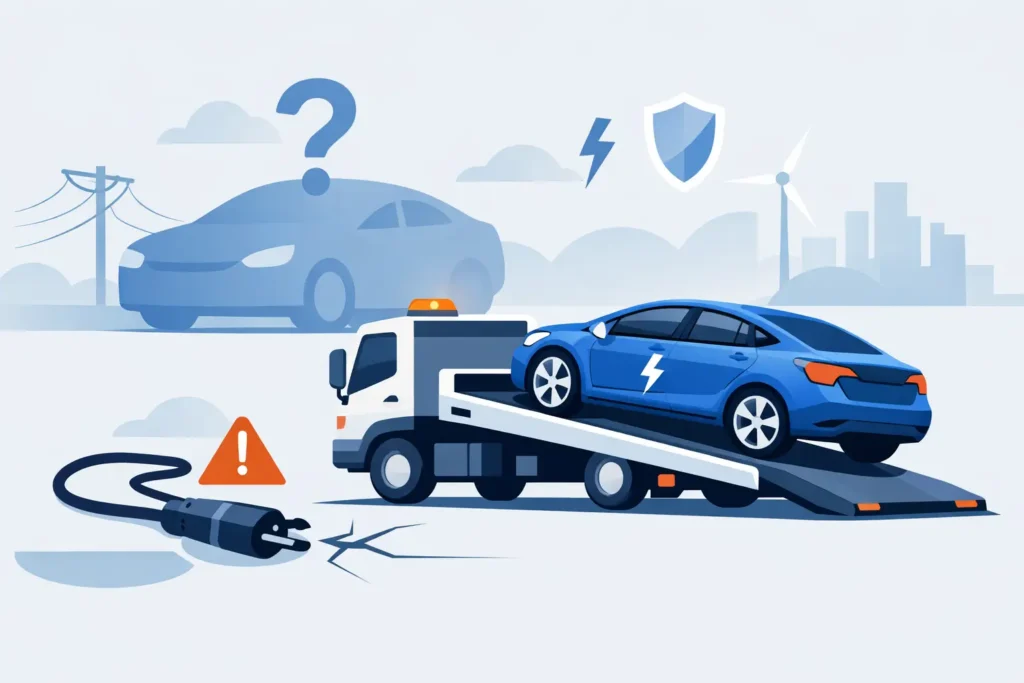
A breakdown on the M4, M25 or a country road around Berkshire is stressful enough without worrying whether recovery will make the problem worse. So, can towing damage electric cars? Yes, it can – if the vehicle is moved with its driven wheels turning when the manufacturer does not allow it. The good news is that a properly equipped recovery operator can transport an EV safely.
Electric cars are not simply petrol or diesel cars with a battery instead of an engine. Their motors, reduction gears, electronic parking brakes and high-voltage systems all affect how they should be recovered. That is why the right method matters from the moment the vehicle stops.
Why towing an EV can cause damage
Many electric vehicles use permanent-magnet motors connected directly to the driven wheels through a single-speed reduction gear. When those wheels rotate, they can make the motor generate electricity – even when the car is switched off or has no usable charge left.
If an EV is dragged or towed with its driven wheels on the road, that generated power may have nowhere safe to go. Depending on the model and the fault, it can put strain on the inverter, motor, battery system or drivetrain. It can also create a risk if the car cannot enter its approved tow or transport mode.
The issue is not identical for every EV. Some models permit limited recovery with specific wheels raised, while others have a manufacturer-approved neutral or transport setting. A few may allow short, slow towing in tightly defined circumstances. However, these exceptions are not a green light to attach a rope and pull the car to the next garage.
A recovery operator should always follow the vehicle manufacturer’s instructions for that make and model. Guessing can turn a simple flat battery, puncture or warning light into an expensive repair.
Can towing damage electric cars with a rope or tow bar?
In most cases, rope or tow-bar recovery is the wrong choice for an electric car. It is hard to control the speed, distance and wheel rotation, and it may be impossible to ensure the electronic parking brake stays released. If the vehicle has lost 12-volt power, even selecting neutral or releasing the parking brake can be difficult.
There are other practical risks on busy roads. EVs are often heavier than comparable petrol cars because of their battery packs. A sudden pull, harsh braking or incorrect attachment point can damage bumpers, undertrays, steering components or the recovery eye. On a motorway hard shoulder or live lane, a makeshift tow also leaves both drivers exposed for longer.
For these reasons, a rope should be treated as an emergency measure only where the manufacturer specifically permits it, the situation is safe and the move is exceptionally short. It is not a sensible plan for transporting an EV home, to a charging point or to a repairer.
The safest recovery method for an electric car
A flatbed or slide-bed recovery vehicle is normally the safest option. It keeps all four wheels off the road, so the drivetrain does not rotate during transport. It also gives the operator control over loading angle, winch speed and the vehicle’s position on the bed.
Where a flatbed cannot be positioned immediately, wheel dollies or skates may be used to move a non-running EV without turning the wheels. This is especially useful if the car is locked in park, has a seized brake or has suffered suspension, axle or collision damage.
Safe loading is about more than putting the car on a bed. The recovery team should use approved tow-eye points or suitable wheel restraints, avoid placing straps near the battery casing or high-voltage cabling, and secure the vehicle without damaging its bodywork. Low-slung EVs also need careful ramp angles to protect the front bumper and underbody.
At Ozzy’s Breakdown Recovery, EV recovery is handled with dedicated equipment and a practical approach: assess the vehicle, choose the correct loading method and get it to a safe destination without unnecessary risk.
What to do when your electric car breaks down
Your first priority is always personal safety. If you stop on a motorway, get behind a safety barrier where possible and follow the instructions from the relevant road authority. Do not stand between vehicles or attempt to inspect the underside of the car near moving traffic.
Once you are safe, switch on the hazard lights and check the dashboard message. If the car reports a high-voltage fault, battery damage, overheating, smoke, a burning smell or warning lights after an impact, move away from the vehicle if it is safe to do so. Do not touch orange cables, attempt a battery repair or connect charging equipment.
When arranging recovery, tell the operator that the vehicle is electric and share the make, model and location. Explain whether it has simply run out of charge, has a puncture, is locked in park, has lost 12-volt power or has been involved in a collision. That information helps ensure the right recovery vehicle and equipment arrive first time.
If you can access the handbook or manufacturer app safely, look for the recovery, towing or transport instructions. Do not rely on advice for another EV model. A Tesla, Nissan Leaf, Kia EV6, Volkswagen ID.3 and electric van can all have different requirements.
Running out of charge is not the same as a normal breakdown
A flat traction battery does not automatically mean the EV is damaged. Often, the vehicle needs either roadside charging support where available or transport to a suitable charging point. But even with zero displayed range, the car may still be in park and unable to be conventionally towed.
Avoid repeatedly trying to restart or drive an EV once it has reached zero. The car may need a small reserve of energy to release systems, select a mode or complete a controlled shutdown. If it will not move, a professional recovery is the safer choice.
It is also worth remembering that the 12-volt battery can fail independently of the main battery. A flat 12-volt battery can leave an EV apparently dead, prevent it unlocking or stop it engaging drive. A correct jump-start procedure may solve the issue, but it must be carried out through the designated 12-volt terminals, never through high-voltage components.
Accident-damaged EVs need extra care
After a collision, the risks change. Damage beneath the vehicle can affect the battery enclosure, even if the bodywork looks relatively minor. A battery pack may be exposed to impact, moisture or internal damage, and faults can develop later rather than immediately at the roadside.
The vehicle should not be dragged from a ditch, pavement or barrier by an unsuitable point. It may need controlled winching, dollies or specialist lifting to prevent further underbody damage. If there is heat, smoke, hissing, visible fluid, a strong chemical smell or repeated warning messages, keep clear and alert emergency services.
A professional team will also consider where the EV is taken and how it is parked after recovery. A vehicle with suspected battery damage may need isolation and assessment rather than being left tightly packed among other cars.
The simple rule for safe EV transport
Do not assume an electric car can be towed like an older petrol car. The safest default is to keep every wheel off the ground on a flatbed, unless the manufacturer’s instructions clearly state another approved method and the recovery team can carry it out correctly.
If your EV stops in Berkshire, South Oxfordshire or on nearby routes, tell the recovery operator exactly what has happened and ask for EV-compatible transport. A calm, accurate call at the roadside helps get the right vehicle to you quickly – and gives your electric car the careful handling it needs.