


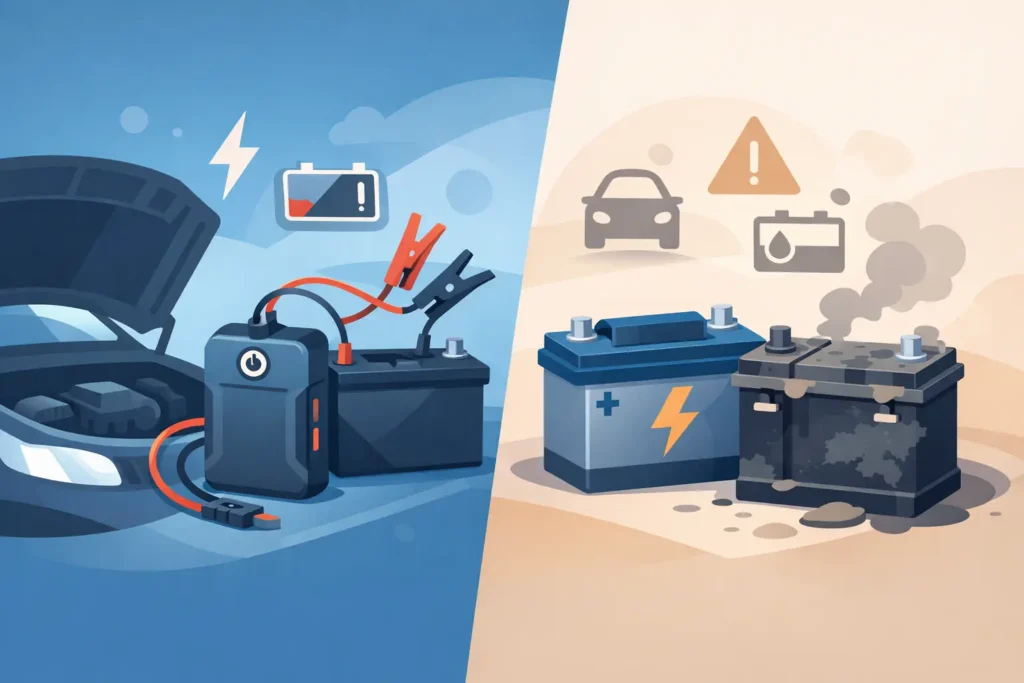
A car that will not start can turn an ordinary journey into a stressful stop, especially on the M4, M25, M3 or a busy local road. The immediate question is usually jump start or battery replacement: can the vehicle be safely started and driven, or has the battery reached the end of its working life? The right answer depends on what caused the flat battery, how the car behaves after a boost, and whether there could be another fault behind it.
At Ozzy’s Breakdown Recovery, we provide fast, reliable 24/7 roadside assistance across Berkshire, South Oxfordshire and surrounding areas. If you are stranded, the priority is getting you safe first, then assessing the most practical next step for you and your vehicle.
When a jump start may be enough
A jump start can be the right solution when the battery has simply been drained by something temporary. Leaving interior lights, headlights or an accessory on can flatten even a healthy battery. Cold weather can also make it harder for a battery to deliver enough power to start the engine, particularly if it was already partly discharged.
You may only need a jump start if the car was running normally before it was parked, there are no ongoing electrical problems, and the engine starts cleanly once power is supplied. After a successful start, a reasonable drive may allow the alternator to put some charge back into the battery. However, this is not a guarantee that the problem has gone away.
A jump start gets the engine running. It does not repair a worn battery, a charging fault or an electrical drain. Treat it as a useful roadside solution, but pay attention to what happens next.
Signs the battery was temporarily flat
A one-off flat battery is more likely where you can identify a clear cause, such as a door not shutting properly and leaving a cabin light on. The vehicle may have started without hesitation in recent days, and it should restart normally after being driven.
If the engine restarts later the same day and again the following morning, the battery may have recovered well enough. Even then, it is sensible to keep an eye on it, particularly before a long trip, an early work journey or travel during colder months.
When battery replacement is the safer choice
A battery replacement is often the better option when flat starts keep happening or the battery is showing its age. Most car batteries do not last forever. Their life can be shortened by short journeys, winter temperatures, frequent stop-start driving and high electrical demand from heated screens, lights and in-car technology.
If you have needed more than one jump start within a short period, do not assume another boost will solve it. Repeatedly relying on a jump start can leave you stranded again at the least convenient time, whether that is outside your home, in a car park or on a motorway route.
Common warning signs include slow cranking when starting, dim dashboard lights, electrical functions behaving erratically, a battery warning light, or a vehicle that starts after a boost but will not restart once switched off. A swollen or leaking battery is a clear reason not to continue using it. Keep away from it and arrange professional help.
The age of the battery matters
If the battery is several years old and has become unreliable, replacement is usually more sensible than repeated callouts. You may not know exactly when it was fitted, particularly with a used vehicle, but a garage can check its condition and charging performance.
It is also worth remembering that a new battery will not fix every no-start fault. A failing alternator may not be charging the battery while you drive. Corroded terminals, loose connections, a starter-motor problem or an electrical drain can produce similar symptoms. A professional assessment helps avoid spending money on a battery when another fault needs attention.
Jump start or battery replacement: what should you do at the roadside?
If your vehicle will not start, put safety ahead of speed. Move only if it is safe and possible to do so. Switch on your hazard warning lights, keep clear of moving traffic and do not stand between vehicles. On a motorway, use a place of safety where possible and follow the appropriate motorway safety guidance.
Do not attempt a jump start if the battery casing is cracked, swollen, leaking or giving off a strong sulphur-like smell. Do not smoke or use naked flames nearby. If you are unsure about the correct jump points, battery type or cable connections, it is better not to guess. Incorrect connections can damage vehicle electronics and create a safety risk.
Modern vehicles can be more sensitive than older cars. Start-stop systems, hybrids, vehicles with multiple batteries and electric vehicles may have specific recovery requirements. An EV’s 12-volt battery can still go flat, but its high-voltage system must never be handled as though it were an ordinary car battery. Professional, EV-aware recovery is the sensible option.
Why a quick boost is not always the cheapest answer
When you are late for work, collecting children or trying to get home, a jump start feels like the fastest fix. Often, it is. But the cheapest immediate option is not always the best value if the vehicle keeps failing to start afterwards.
A battery that cannot retain charge can leave you needing another recovery callout within days. Equally, replacing a battery without checking the charging system can mean fitting a new one only for it to be drained by an alternator or wiring fault. The practical decision is based on the vehicle’s symptoms, battery condition and your plans for the next journey.
For a one-off drain, a jump start and monitoring may be enough. For repeated failure, an older battery or visible battery damage, replacement and further checks are normally the safer route. If you cannot be confident the vehicle will restart, arranging recovery to a trusted garage can prevent further disruption.
What to tell your roadside recovery provider
Clear information helps a recovery team arrive prepared and saves valuable time. Tell them your exact location, the vehicle registration, make and model, and whether you are in a safe place. Mention whether the engine turns over, whether any warning lights are showing, and whether the battery has been jump started recently.
If you drive a van, operate a business vehicle or are carrying tools, stock or passengers, say so when you call. Downtime matters, and the right recovery equipment and plan can make a difficult situation far more straightforward. Motorcycle, commercial vehicle, non-runner and EV callouts may require different handling from a standard car jump start.
A good recovery service will focus on getting you out of danger, explain the realistic options clearly and handle your vehicle with care. Sometimes that means a quick roadside start. Other times, safe transport is the better decision.
Avoiding another flat battery
You cannot prevent every breakdown, but a few simple habits can reduce the chance of a flat battery. Make sure lights and accessories are switched off when leaving the vehicle, especially if you do short journeys. If the car is not used regularly, consider taking it for a proper run or using an appropriate battery maintainer.
Have slow starting checked before it becomes a no-start. Clean, secure battery terminals and a healthy charging system make a real difference. Before a longer journey, particularly in winter, do not ignore warning lights or an engine that is becoming harder to start.
If your car will not start, do not let uncertainty make the situation worse. A fast, professional assessment can establish whether a jump start will get you moving or whether battery replacement or recovery is the safer next move. Keep yourself safe, share your location clearly and get help before a small battery problem becomes a longer delay.