


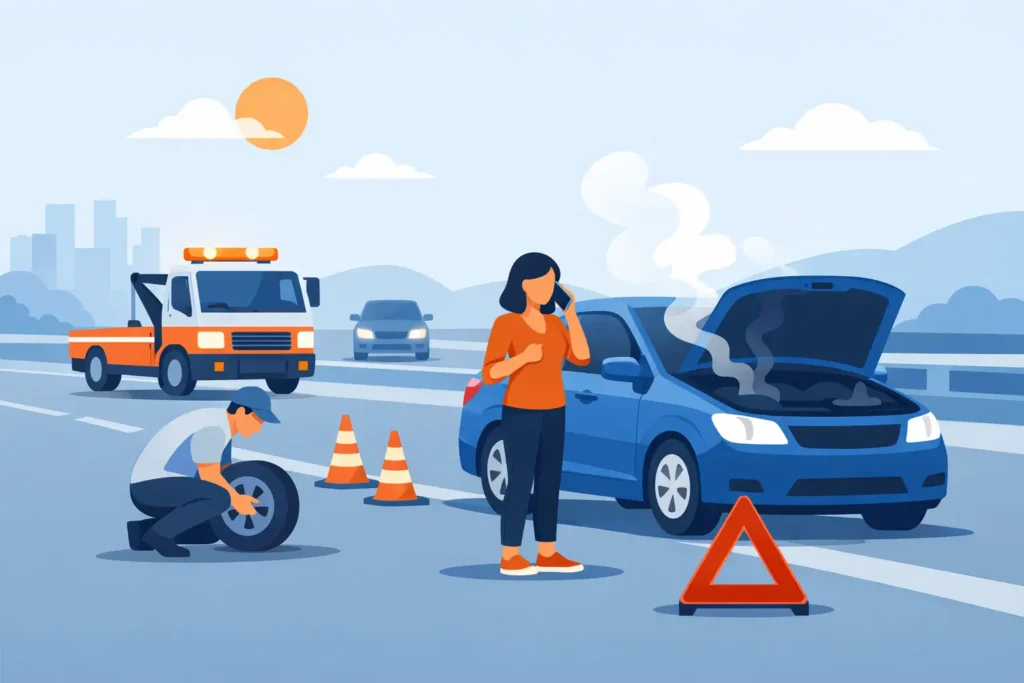
A warning light, a flat tyre or an engine that suddenly loses power can turn an ordinary journey into a stressful roadside breakdown in seconds. Knowing how to handle roadside breakdown situations calmly gives you the best chance of keeping yourself, your passengers and other road users safe while help is arranged.
Your first job is not to diagnose the fault or get moving again. It is to get out of danger. Whether you are on a quiet Berkshire lane, outside Reading, or travelling on the M4, M25 or M3, put safety before the vehicle every time.
How to handle roadside breakdown safely
As soon as you realise there is a problem, reduce speed smoothly and look for the safest place to stop. Avoid harsh braking or sudden steering, particularly if you have a tyre issue, warning light or loss of power. Switch on your hazard lights as soon as other drivers may need warning.
On an ordinary road, pull over as far to the left as is safely possible. Choose a lay-by, car park, service station or wide verge where you can leave space between your vehicle and moving traffic. Avoid stopping on a bend, near a junction, at the brow of a hill or anywhere drivers will have little time to see you.
Once stopped, apply the handbrake, select park or neutral as appropriate, and switch off the engine if it is safe to do so. At night or in poor weather, leave your sidelights on if needed to make the vehicle more visible. If you smell fuel, see smoke, or suspect a fire, move everyone well away from the vehicle and call 999 immediately.
Do not put yourself at risk trying to fix the problem beside a live carriageway. A simple-looking issue can wait. Passing traffic cannot.
If you break down on a motorway or smart motorway
Motorway breakdowns need extra care because traffic is faster and drivers may have less time to react. If the vehicle is still moving, aim for the next motorway service area, exit or emergency area. Do not stop in a live lane unless the vehicle cannot be moved any further.
If you reach the hard shoulder, pull as far left as possible, turn on your hazard lights and leave the vehicle by the left-hand doors if it is safe. Passengers should exit on the left too. Move behind the safety barrier and stand well away from the road, ideally upstream of the vehicle so you are not directly behind it if it is struck.
On a smart motorway, use an emergency area whenever you can. These are marked with blue signs featuring an orange SOS symbol. If you are forced to stop in a live lane and cannot move, keep your seatbelt on, turn on hazard lights and call 999. Tell the operator that you are stopped in a live motorway lane. If it is safer to remain in the vehicle, stay inside with your seatbelt fastened until emergency services advise otherwise.
Use the roadside emergency telephone where one is available, especially on a motorway. It helps the operator identify your precise location. If you call from a mobile, use motorway marker posts, the direction of travel, junction numbers, nearby signs or your phone’s map location to explain exactly where you are.
Get passengers to a safe place
Children, older passengers, pets and anyone with limited mobility need particular consideration. On a quiet road, it may be safest for everyone to wait away from the carriageway, somewhere visible but protected. On a motorway hard shoulder, get behind the barrier if it is safe to do so.
The right choice depends on the road and the immediate danger. Do not cross a motorway, do not stand in front of or behind your vehicle, and do not let children wander near traffic. If you are stopped somewhere with no safe place to wait outside, such as a live lane, keep occupants restrained in the vehicle and call 999.
If you have a high-visibility jacket, wear it before leaving the vehicle. It can help other drivers see you, but it does not make roadside repairs safe. Keep everyone together and make sure phones are charged where possible.
Call for the right kind of recovery
When you contact a recovery provider, clear information helps them send the right vehicle and equipment without delay. Give your exact location first, then explain what has happened and whether you are in immediate danger.
A recovery team will usually need your vehicle registration, make and model, the nature of the fault, and whether the vehicle can roll and steer. Mention any special circumstances, such as a locked wheel, axle damage, accident damage, a flat battery, a puncture, or an electric vehicle with no charge. For motorcycles, vans and commercial vehicles, say so at the start – they may need different loading equipment or a suitable recovery vehicle.
Also explain where you want the vehicle taken. That might be your home, a trusted garage, a dealership, a charging point or another safe location. If your vehicle is blocking access, in a dangerous position or carrying business equipment, say that clearly. The recovery operator can then prioritise the call properly.
For drivers across Berkshire, South Oxfordshire and nearby motorway routes, Ozzy’s Breakdown Recovery provides 24/7 emergency assistance, with professional recovery for cars, vans, motorcycles, non-runners, accident-damaged vehicles and EVs. A clear call at the roadside helps get the right help heading your way quickly.
What not to do at the roadside
A breakdown can make people feel rushed, especially when they are late for work, collecting children or managing a delivery schedule. That is exactly when poor decisions happen. Do not accept help from an unmarked vehicle if you are unsure who they are, and do not get into a stranger’s vehicle unless directed by the emergency services or you are confident it is safe.
Avoid opening the bonnet on a motorway or attempting to change a tyre beside fast-moving traffic. Even on a quieter road, a wheel change may be unsafe if the ground is uneven, visibility is poor or the vehicle is too close to traffic. Professional recovery is often the safer option, particularly for larger vans, electric vehicles and cars with damage that may not be obvious.
Do not leave valuables on display if you need to step away from the vehicle. Take your phone, keys, driving licence, medicines and any essential items with you. If the vehicle must be left unattended, lock it if safe to do so and tell the recovery team where the keys are.
Be ready before the next journey
You cannot prevent every mechanical failure, but a few checks make breakdowns less likely and easier to manage. Check tyre condition and pressure regularly, keep enough fuel or battery charge for the journey, and pay attention to warning lights before they become urgent. For EV drivers, plan charging stops with a sensible buffer rather than relying on the final few miles of range.
It also helps to keep your phone charged and carry a charging cable, warm layer, drinking water and a basic first-aid kit. A torch is useful in winter or on unlit rural roads. These items will not repair the vehicle, but they can make the wait safer and more comfortable.
If your vehicle loses power, develops a fault or is involved in an accident, take a breath, make the safest move you can, and call for professional help. Your journey can be rearranged. Your safety cannot.