


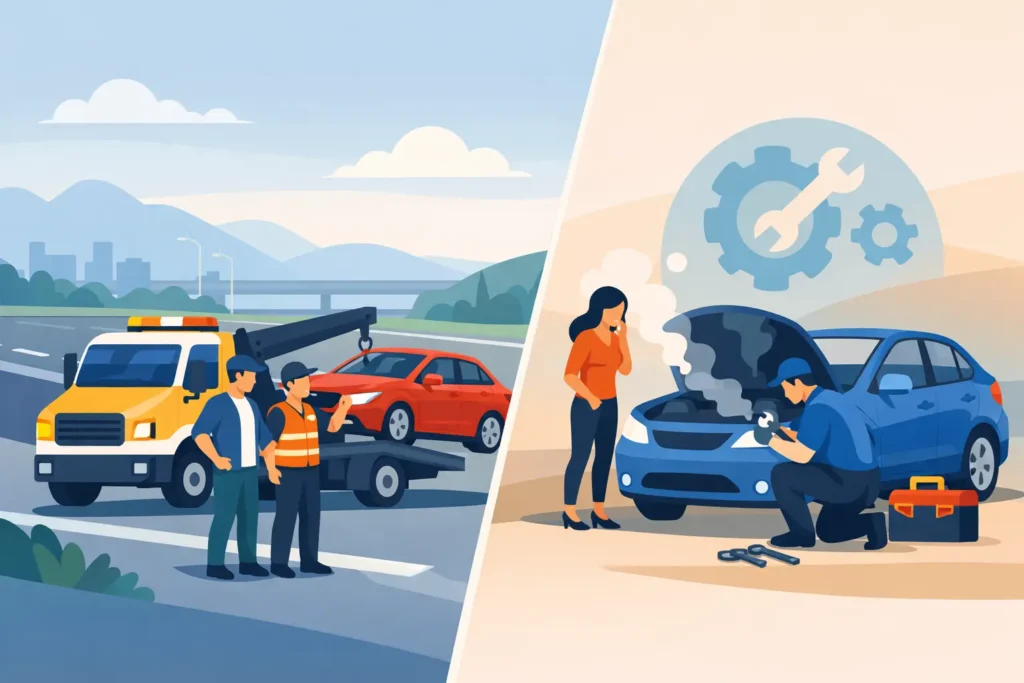
A warning light on the M4 near Reading, a flat battery outside work, or a van that will not restart before the next delivery all create the same immediate problem: you need help now. The difference between roadside recovery vs breakdown cover is mainly about how that help is arranged, paid for and delivered when your vehicle cannot continue.
Breakdown cover can be useful reassurance for planned protection. Roadside recovery is the direct, on-demand service that gets a vehicle moved or made safe when it has already broken down, been damaged or cannot be driven. Knowing which applies means less time spent on hold and more time getting your journey, vehicle or business back on track.
What is breakdown cover?
Breakdown cover is an insurance-style membership or policy arranged before anything goes wrong. You usually pay monthly or annually and receive assistance within the level of cover you have selected. Depending on the provider and policy, this may include roadside repair, recovery to a garage, onward travel, home start and sometimes a replacement vehicle.
The key word is “may”. Cover levels, call-out limits, distance limits, exclusions and waiting periods vary. A basic policy might send assistance to repair a simple fault at the roadside or take you to a nearby garage. A more comprehensive policy may offer national recovery or transport for passengers. It is worth checking the small print before relying on it.
Breakdown cover can suit drivers who want a predictable annual cost and regularly travel further from home. It can also make sense for households with several cars, or businesses that have arranged fleet assistance in advance.
However, having a policy does not always mean the fastest possible solution. You may need to contact the provider first, give your membership details, wait for them to allocate a contractor and follow their process. If the fault falls outside the policy terms, or the vehicle needs specialist handling, there may be additional costs or limits on what can be done.
What is roadside recovery?
Roadside recovery is a direct recovery service requested when you need it. Rather than claiming through a membership scheme, you call a local recovery operator, explain the situation and arrange the appropriate help and price for that job.
This is not limited to a straightforward mechanical breakdown. A professional recovery service can help with accident-damaged vehicles, non-runners, flat batteries, punctures, lost mobility caused by axle damage, motorcycles, vans and electric vehicles. If a safe roadside repair is not possible, the vehicle can be loaded and transported to a garage, home, workplace or another agreed destination.
For motorists stranded in Berkshire, South Oxfordshire or on busy routes such as the M25, M4 and M3, direct recovery is often the practical answer when there is no active cover, the insurer cannot meet the urgency of the situation, or the vehicle needs more than a basic fix. Ozzy’s Breakdown Recovery operates 24/7, with dedicated recovery equipment and typical response times of 30 to 45 minutes where conditions allow.
Roadside recovery vs breakdown cover: the practical difference
The most useful way to compare roadside recovery vs breakdown cover is to look at what happens in the first few minutes after your vehicle stops.
With breakdown cover, you contact your provider and they decide how the case is handled under your policy. The service may be included, partly covered or excluded according to the fault, location, vehicle type and cover level. This can work well when your policy clearly covers the situation and the allocated assistance can reach you promptly.
With roadside recovery, you speak directly to the team handling the call-out. You can explain whether you are on a live motorway, outside your home, carrying tools in a van, travelling with children or dealing with a vehicle that has been involved in a collision. The operator can send the right recovery vehicle and give you clear instructions while you wait.
The trade-off is straightforward. Breakdown cover spreads some costs in advance but comes with terms and processes. Direct recovery is paid for at the point of need, but it can provide greater flexibility, clearer communication and a service tailored to the actual vehicle and location.
Speed and control
In an emergency, speed matters, but so does knowing who is responsible for the next step. A direct local recovery provider can often give a realistic response estimate and update you if traffic, weather or road closures affect arrival. You are arranging the recovery yourself rather than being passed through a national dispatch system.
That control is especially valuable if you need the vehicle taken to a particular repairer, need to collect a motorcycle safely, or need a commercial van moved quickly to reduce missed jobs. Always confirm the destination and any access requirements when you call.
The type of vehicle and damage matter
Not every breakdown is a dead battery. A vehicle with a damaged wheel, broken suspension, locked steering, flat tyre, collision damage or an electric fault may need specialist loading. Attempting to tow it incorrectly can make the damage worse and create a danger for other road users.
A proper recovery service assesses whether the vehicle can be repaired at the roadside, winched, lifted or transported on a recovery vehicle. This matters for EVs too. Electric vehicles have specific recovery considerations, and they should be moved using suitable equipment and methods rather than treated as any ordinary non-runner.
Where you have broken down
Location changes the urgency. A car on a quiet residential road is different from a vehicle stopped on a motorway slip road or a busy section of the M4. If your vehicle is in a hazardous position, put safety first: switch on hazard lights, leave the vehicle only when it is safe to do so, and move behind a barrier where available. On a motorway, follow official road safety guidance and contact emergency services if there is an immediate danger.
Once you are safe, give the recovery operator the clearest location possible. A motorway junction number, direction of travel, nearby landmark, postcode or what3words reference can save valuable time. Mention the vehicle registration, make, model, colour, fault and whether it is blocking traffic.
When should you use your breakdown cover?
Use your breakdown cover when it is active, the incident is within its terms and you are comfortable using the provider’s arranged service. It is a sensible first option for a routine fault, particularly if you have comprehensive cover and are not under severe time pressure.
Before calling, check whether you have home start if the vehicle will not start on your drive, and whether your policy includes recovery rather than roadside assistance only. A common surprise is discovering that a low-cost policy will attend but only take the vehicle a limited distance.
You should also check whether commercial use, vans, modified vehicles, trailers or motorcycles are included. A policy attached to a personal car may not cover the vehicle you are driving for work.
When is direct roadside recovery the better choice?
Direct roadside recovery is often the better choice when you need prompt local help, have no policy, cannot wait for a membership provider’s process, or need a specialist recovery job. It is also useful when you want a clear agreement on where the vehicle is going and what type of transport it requires.
For a damaged non-runner, a motorcycle that cannot be ridden, a van carrying equipment, or an EV that needs careful handling, explain the situation in full at the start. The right vehicle can then be dispatched rather than arriving with equipment that is unsuitable for the job.
Businesses should consider the cost of downtime as well as the call-out charge. A stranded light commercial vehicle can mean missed appointments, delayed deliveries and a driver left unable to work. Fast, reliable recovery can be the more economical option when it gets the vehicle and driver to the right place without further delay.
What to tell a recovery operator
A short, accurate description helps arrange safe assistance quickly. Have your exact location, vehicle registration, make and model ready, along with a simple explanation of the fault or damage. Say whether the vehicle starts, rolls and steers, and mention any passengers, cargo, trailer or access issue.
If you have been in an accident, tell the operator about visible damage, deployed airbags, leaking fluids or wheels pointing in the wrong direction. Do not attempt to drive a vehicle that feels unsafe or has serious damage, even if it can still move.
You do not need to know the mechanical diagnosis. You only need to describe what happened and what the vehicle is doing. A dependable recovery team will ask the right questions and send suitable help.
When you are stranded, the best option is the one that gets you safe, keeps you informed and moves your vehicle properly. Check your breakdown policy before you travel, but if the vehicle is already stopped and you need immediate local assistance, make the call and get the right recovery arranged.